Last summer, on the precipice of the brand’s landmark announcement of its Type 00 concept car, Jaguar hosted a selection of automotive and design journalists from around the globe. Over the course of three days touring through its Oregon facility, the through line of each conversation with the team was a mix of “innovation” and “identity.” “Innovation,” of course, referred to the dynamic Type 00, a car that was visually and technologically unlike anything seen before in the auto industry, let alone from Jaguar. Questions of “identity,” on the other hand, referred to how the brand would balance these daring forays into the future without sacrificing its position as a luxury British heritage brand. The car itself was guided by the decisiveness of Jaguar’s leadership team, and the result spoke for itself. Even so, in a room full of auto journalists, bold deviations are often met with skepticism.
“To me, what the world really needs in order to handle [AI] technology is a strong liberal arts education. We have the technology, but what we need to do is be able to ask the right questions. I think one of the biggest questions is, ‘Is this really progress?’”
Joshua Vermillion
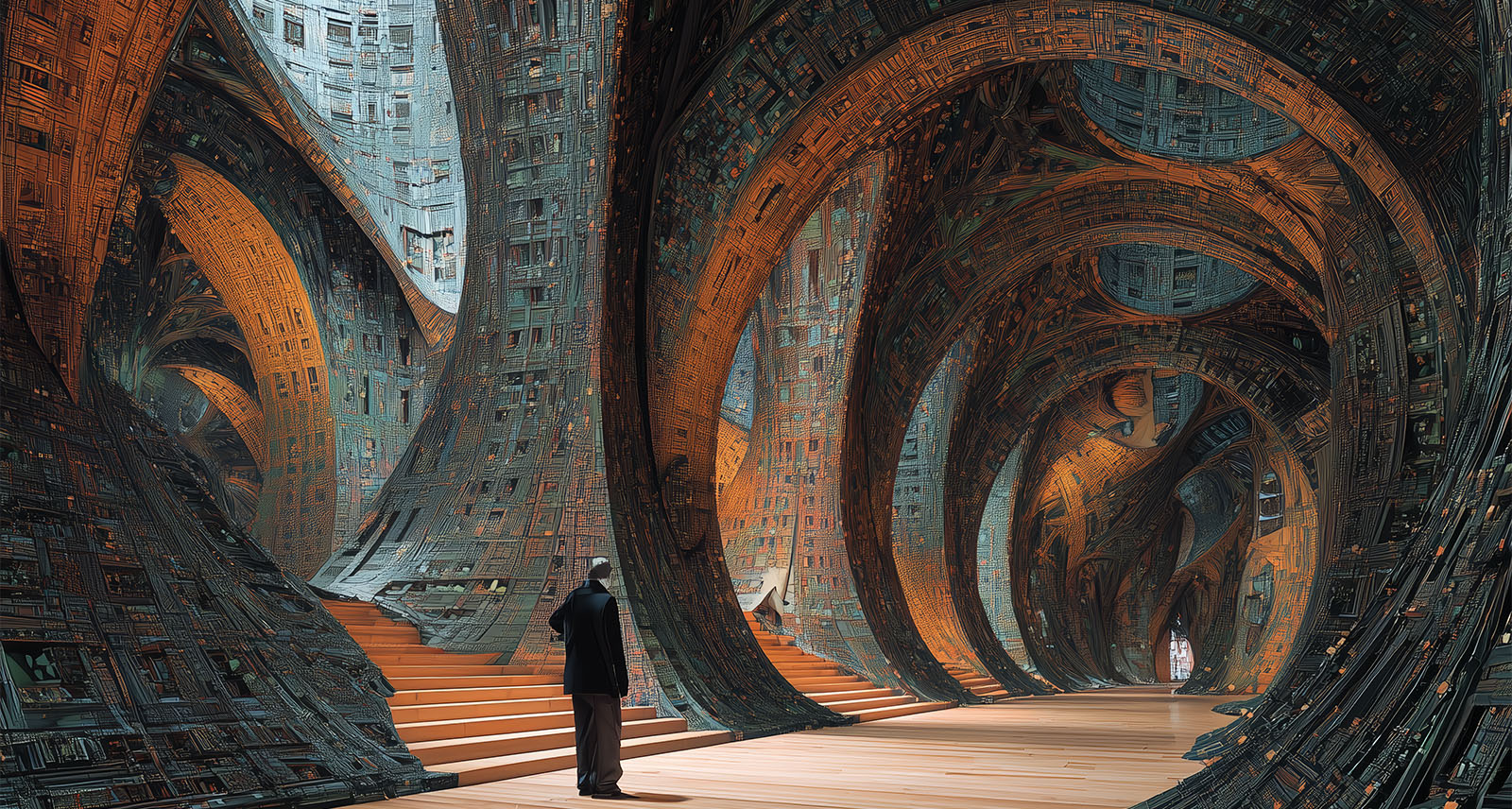
So, on the final day of the trip, Jaguar brought forth an expert in the field of design and innovation, Joshua Vermillion, whose work in architecture, education, and artificial intelligence made him well-suited to fielding skepticism. It takes a brave man to join a three-day trip alongside writers and editors to present one’s work in AI. Vermillion had grown — and continues to grow — a rabid online following due to his grand otherworldly AI architectural designs. Each image Vermillion presented was simultaneously familiar and alien, featuring vaulted halls and winding pillars made of objects recognizable to our real-world and eerily appropriated into something new. At the time, the general public’s exposure to AI was mostly in the context of large language models such as ChatGPT — tools that were, in essence, threatening to replace original written work. It would be as if the inventors of the telegraph walked into the headquarters of the Pony Express to show off their novel technology. But mere minutes into meeting Vermillion, it becomes clear that the associate professor at UNLV’s School of Architecture isn’t an AI evangelist. Instead, he speaks with great nuance and reverence for fields of ethics and creativity, and outlines how new technologies might supercharge human ingenuity, not replace it.
“When I started my professional design training, we were very much in a transition from an analog world to a digital world. So, all I’ve really known in the field is constant change,” Vermillion explains, a year after his presentation with Jaguar. “When I returned to academia after years of working privately as an architect, it was really to give students the tools to create and design in the future. In academia, the prevailing approach is ‘Let’s teach them skills that are relevant right now.’ And, of course, we have to prepare them for the present. But I see it as preparing students to treat technology like we treat sports: run to where the soccer ball is going, not just where it is now.”

The way in which Vermillion talks about innovative design technologies makes it clear why he landed in academia. He’s a natural teacher. Whether in front of a group of journalists eager to take umbrage with emerging technologies or in front of a group of his UNLV architecture students at the forefront of the industry, he distills ideas down to their essence. It isn’t merely a question of how AI can benefit architects but, moreover, how these design technologies can improve policy, sustainability, and the lives of those outside the bubble.
“The real question, above all, is how do we begin to leverage superintelligence in ways that actually help us make a better world?” he poses. “One aspect that we always talk about is productivity, being able to offload the initial grunt work or scaling to AI. But what does that mean for the public that we’re making buildings for? I’m a firm believer that we have way too many lawyers in government. We need more design in public office. The world needs more creativity when it comes to problem-solving. We need to enter the fray of public discussion; we need to run for government. I mean, every neighbourhood needs an architect, damn it. So, if we could become more efficient architects, that would allow us to invest time in other arenas, to do more in our communities. I see something like that as a net positive.”
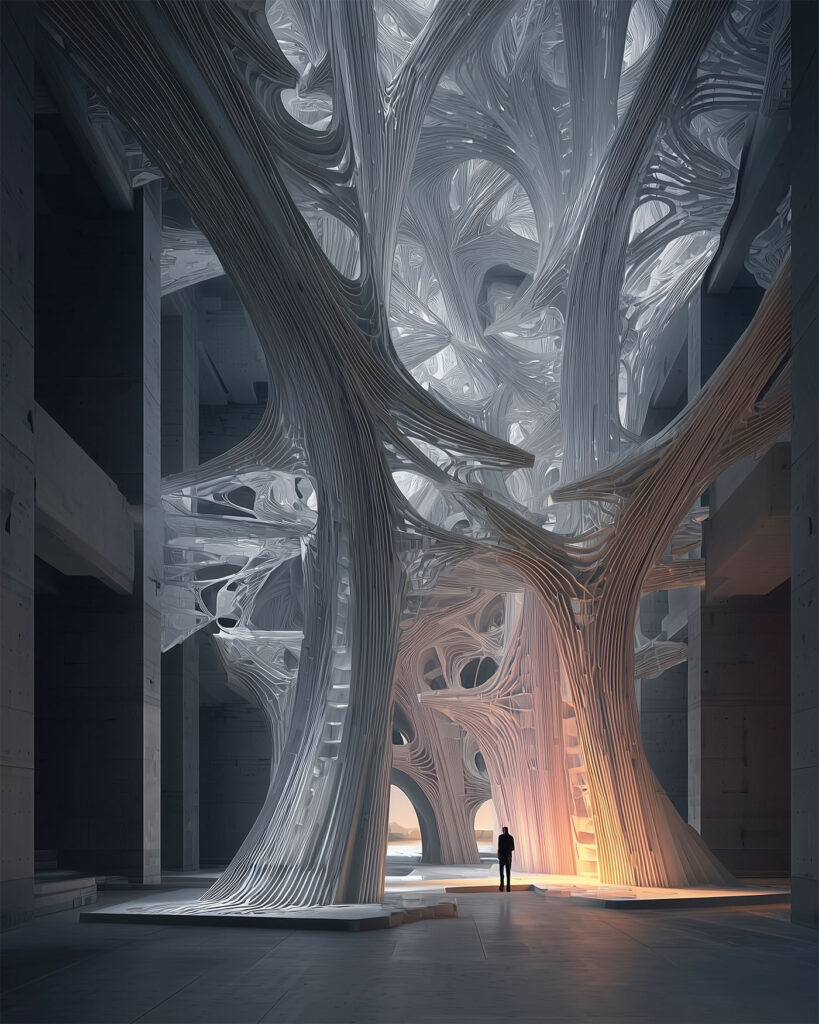
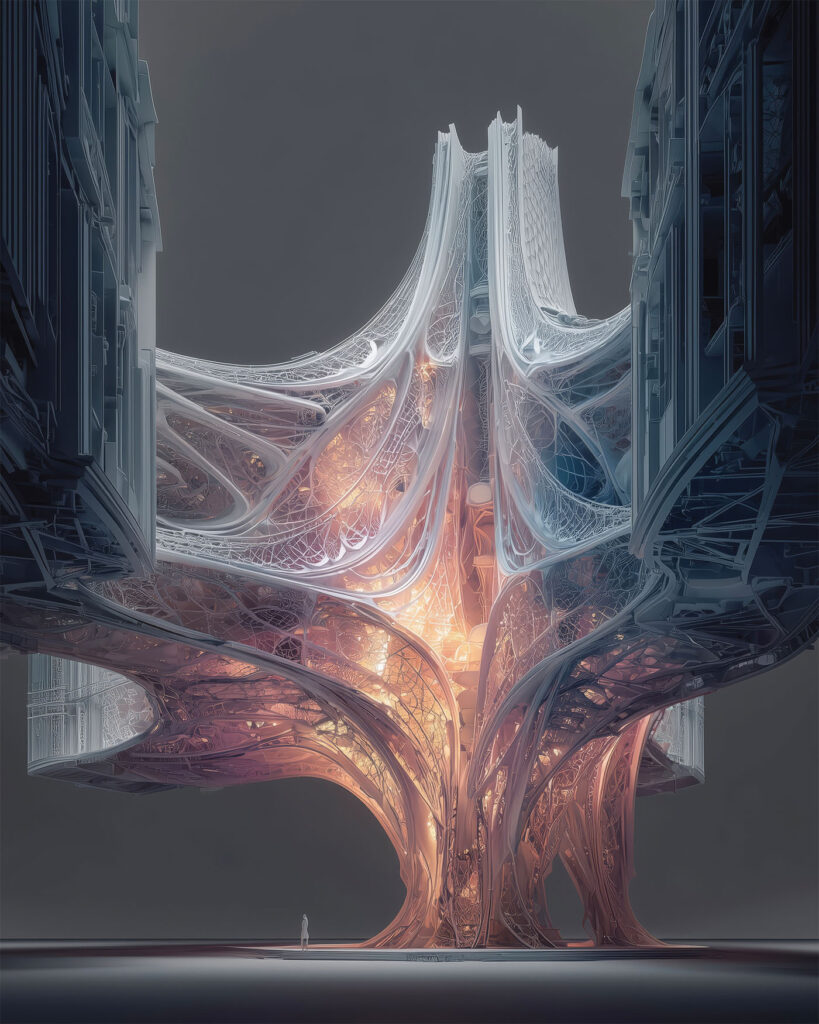
Vermillion isn’t merely an adopter of AI; he’s a scholar in a literal sense. Throughout an hour-long discussion, he makes references to AI’s earliest pioneers who made lofty, societally shifting declarations, similar to his own. He references Geoffrey Hinton, the “godfather of AI,” MIT Media Lab co-founder Nicholas Negroponte, and designer Matias del Campo. He balances theories from professors and designers around the globe, evangelists and skeptics alike, taking each theory with a grain of salt. He describes the hesitancy of his students to use machine learning in their own work for fear of not developing fully as designers. He ideates how large language models might not alienate designers of older generations but, instead, make coding and programming more universally accessible. In mapping the future of machine learning in relation to creativity, Vermillion approaches the subject with the same sensibility one would expect from a philosopher.
“I’m fascinated by the layers of the subject, especially as an educator. Universities are some of the most unique places in the universe to grapple with some of these hard questions, because we’re one of the few places on earth with experts on ethics, on critical thinking, on labour, on creativity,” he says. And he takes in all input. Even while leveraging AI in his own work and travelling around the globe to offer insight as to how this technology might shape our worldview, Vermillion is cognizant to check himself.
“To me, what the world really needs in order to handle this technology is a strong liberal arts education,” he says. “Because we have the technology, but what we need to do is be able to ask the right questions. I think one of the biggest questions is, ‘Is this really progress?’ Every discipline can ask that question in its own unique way, right? I think an ethical philosopher could come up with a different framework for that than, let’s say, somebody thinking about labour and capital, and differently from one of my colleagues in the language or theatre departments. I think what we really need now is to stand back and ask ourselves, ‘What kind of future do we want?’ We certainly don’t want to be in a King Midas situation, where we ask AI for the world, and then we realize that we got what we asked for, but not what we wanted.”
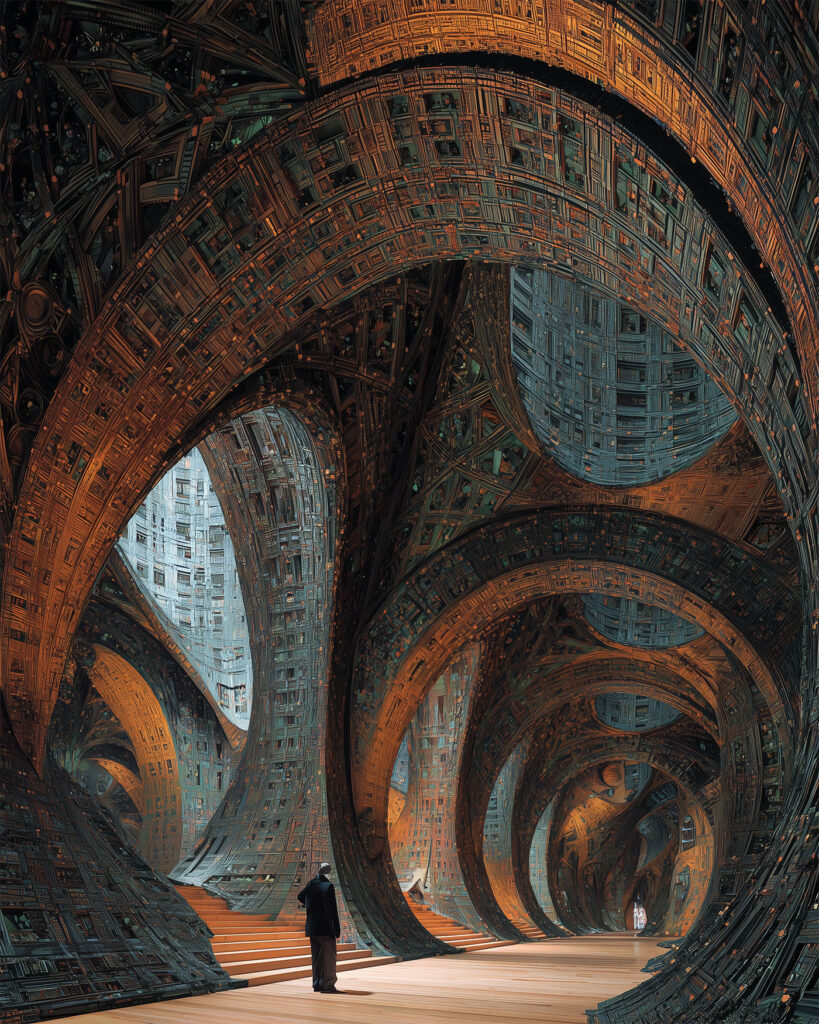
Of course, the AI skeptics won’t be satisfied with nuanced existential queries, as necessary as they might be. Vermillion understands this. After all, while his viral architectural designs might be alien, he lives consciously on earth with the rest of us, acutely aware of AI’s present consequences. “I’m not naive to the fact that some of the technologies are huge consumers of energy and water. We learn more and more about how data centres work. I think about this whenever I’m pushing the button to generate an image, of course.”
“Right now, these systems are concentrating power and money in the hands of the few, even more so than before. […] This isn’t just a question about creativity or commerce. This is a question about our collective future, period. And how do we make these systems work for us and not the other way around?”
Joshua Vermillion
Still, he asserts, it’s nuanced. After all, we make buildings held together with glue, bulldozed the moment they’ve outlived their purpose. We don’t build cities to be disassembled or reused, the way we swap out one car part for another. Vermillion foresees a world where AI could help us achieve sustainable urban environments. “Design is about making decisions. You start with a framework, and then those initial decisions start to lead to subdecisions and secondary decisions, tertiary decisions. But what if we could play out these scenarios much quicker with less wasted efficiency? What if AI can help scale buildings that don’t contribute to urban heat islands and are net producers of energy, rather than just consumers of energy? We’ve left a lot of problems for the next generation to wade through, but I’m positive. I’m optimistic that this technology can help us navigate it.”
The concept of decision-making trees goes beyond design; in our interconnected world, nothing happens in a vacuum. Policy decisions made in AI legislation trickle down to affect how we plan our neighbourhoods. How Vermillion chooses to conduct his architecture classes might ultimately create a ripple effect in UNLV’s theatre department. It’s perhaps impossible to say how our current decisions in machine learning will impact the creativity of generations not yet born. Even so, Vermillion asserts that, if there’s one thing that he’s certain about, it’s that these decisions should be made as a community, not by the privileged few who are handed the keys to AI’s future.

“We can’t fully know the impact of AI, just as Geoffrey Hinton couldn’t have predicted where we’d be today decades ago. But what I do know is that we can’t have just a handful of people controlling everything. That might be a political statement, but I don’t think it is. It’s a humanistic statement. And anybody who thinks that’s a political statement needs to take the red pill and be deprogrammed from the Matrix. Right now, these systems are concentrating power and money in the hands of the few, even more so than before. That’s a huge problem. I don’t have an answer for that. I certainly don’t have an answer for that as an architect. But as a citizen, and as a taxpayer, and as just a simple member of the species of human beings, these decisions need to be made as a collective. This isn’t just a question about creativity or commerce. This is a question about our collective future, period. And how do we make these systems work for us and not the other way around?”