It’s 10 AM on a Monday morning when Tom Blyth hops on our call, but his wavy dark hair and friendly smile show no trace of weekday blues. This isn’t the first time I’ve seen him on screen; I recognize the 30-year-old British actor from his breakout role in The Ballad of Songbirds and Snakes — the film adaptation of Suzanne Collins’ prequel to The Hunger Games — just as you might recognize him from the ongoing Western drama, Billy the Kid, where he’s played the titular role since 2022. Or perhaps you met him a few years earlier, in the back of a taxi cab, where Blyth introduced himself Sid — a lead role in the coming-of-age comedy Scott and Sid.

Whatever the case may be, it’s nearly a guarantee that you’ll be seeing Tom Blyth again. “All my projects seem to be coming out at the same time,” Blyth laughs. He’s halfway through a hectic season, jam-packed with red carpets and pre-release screenings. This year alone, Blyth’s portfolio ranges from thriller (Plainclothes) to romantic comedy (People We Meet On Vacation) to drama (Wasteman, The Fence).
Between premieres and photoshoots, Blyth managed to find time for a quick chat. Below, the British actor tells us all about his creative process, passion for storytelling, and hopes for the future.
We’re based in Toronto; I know you were just here for The Fence at TIFF — how was your visit?
Yeah! I was there for a couple of films, actually. I was there for a film called Wasteman and for The Fence as well. It was great. I had an amazing time. It was my first time at TIFF, so it was cool to attend and be part of something that I’ve been watching from afar for years.

You’re based in New York now; you first moved to attend Juilliard?
Yeah, I went out there for drama school in 2016. I was there for four years and then basically fell in love with the city. I decided I really wanted to stay. My work started picking up here and it made sense to make it my main home.
How did the environment shape your craft? Were there specific exercises or methods that you picked up and continue to use on set?
I think I’d be lying if I said it didn’t, in some way, but I also think my process changes on each job — with each character — depending on the requirements. A lot of what I use to this day, no matter what the process is, stems from training at Julliard. There’s the physical stuff that we got trained in there, derived from Jacques Lecoq and Marcel Marceau. They call it, like, mime work. It’s very disciplined, very physical. I like to bring a lot of physicality into whatever I’m playing, whoever I’m playing. Aside from that, being in New York played a big part in making me who I am today — almost as much as doing the training itself. Coming from a small city in the UK, I found I almost apologized, when I was younger, for existing. I almost apologized for taking up space. Moving to the States, specifically to New York — where it is such a melting pot of people, who are all ambitious, all trying to express themselves, and not afraid to do so — I realized it would be beneficial to not be so apologetic.
What does getting into character look like for you? When you first read a script, see where the project is set, the themes that it’s dealing with — do you try to familiarize yourself by researching real life events?
As soon as I have the script in my hand, I read it a ton of times. If it’s based on true events, or even if it just takes place at a certain point in history, I’ll go and read as much as I can about that time, that place, those events. If I’m [playing] a real person, even more so. I’ll listen to the music of that time or try to immerse myself in the culture of that time, because I think that all makes up who we are. If, in 20, 30 years’ time, you’re doing a period piece about the 2020s, about 2025, you’d be going and listening to what people are listening to. You’d be like, “Oh, how does listening to Sabrina Carpenter every day, or Lola Young, or whatever it might be — the musicians of today — how does that affect you? How does that make you feel?” Music is a big part of it for me. On Plainclothes, we had a big, long playlist of ‘90s music. I do the same thing when I’m doing Billy the Kid. I listen to a lot of old country songs or old Western ballads — modern country too. Whichever world I’m in, I tend to get quite immersed in the culture of that world. My inner child gets quite obsessed with whatever it is that I’m working on.
Another project of yours, People We Meet On Vacation, is coming out soon. The source material is a novel so — before the film comes out — the audience is already familiar with the characters. What is your relationship to the novel?
I wasn’t familiar with People before. I must have seen it. I mean, it’s hard to avoid Emily Henry these days — she’s such a prolific modern writer — but I wasn’t super familiar. So, I got sent the script and obviously read it and I decided to do the part. Then, I read the book. For me, especially, the script really honours the book. The film really honours the book. But at a certain point, I just have to stick to the script. It’s the guidelines. It’s the boundaries. It’s the North Star, it’s the compass — so many metaphors for what I’m trying to say. So, I read the book and I find it helpful, but not as helpful as the script. I think, if anything, it fills in some gaps; it gives me some extra character pointers. If I’m ever lost, I can go back to it. But, at a certain point, you read the book and then you let it go. You want to stay present. You want to stay in the moment with your scene partner, with the director, and usually the script is what helps you do that.
“If everyone’s all in and you’ve got a director who has passion and a clear vision, then — no matter the genre, no matter the budget or scale — it just feels like filmmaking. I love that process.”
Tom Blyth
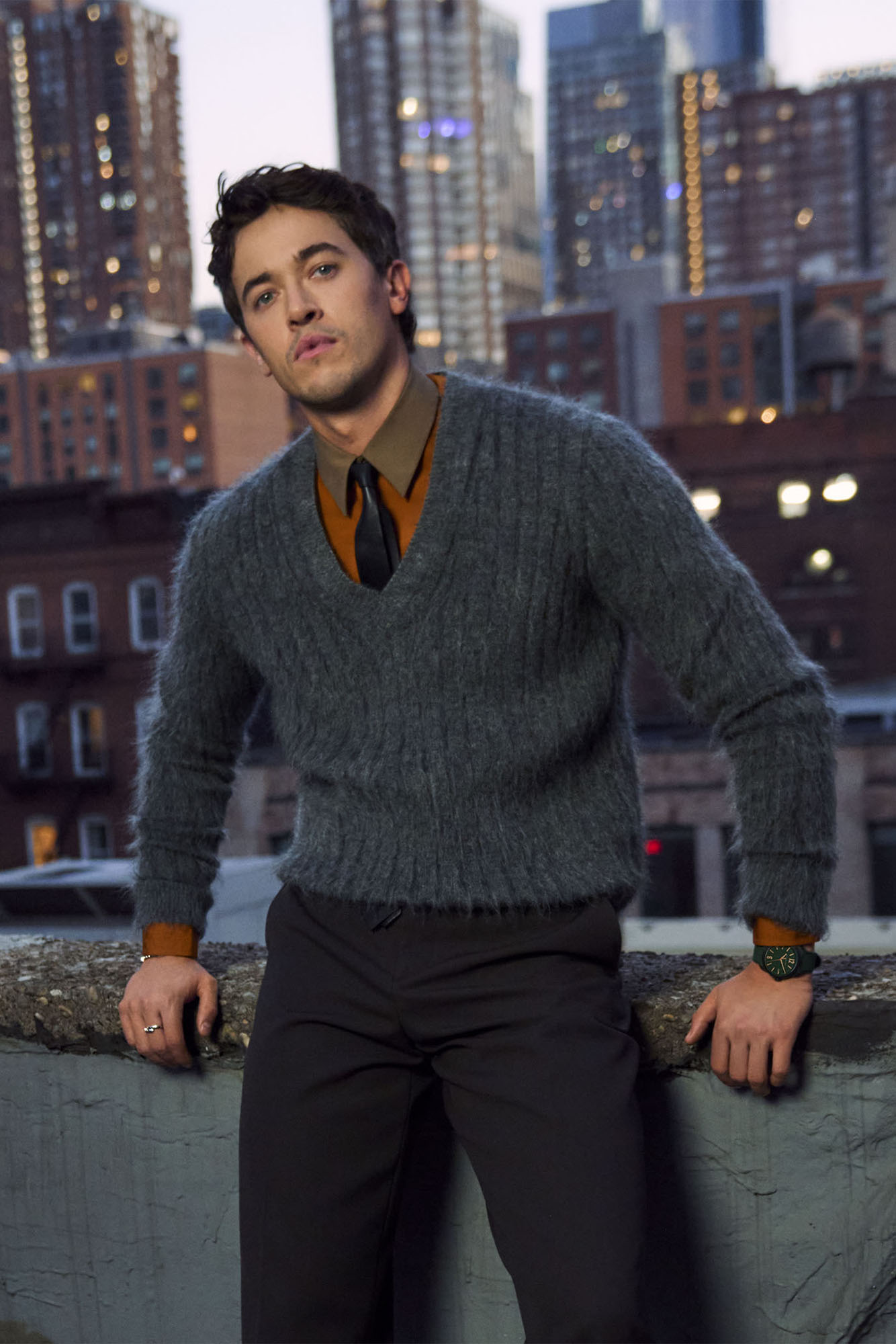
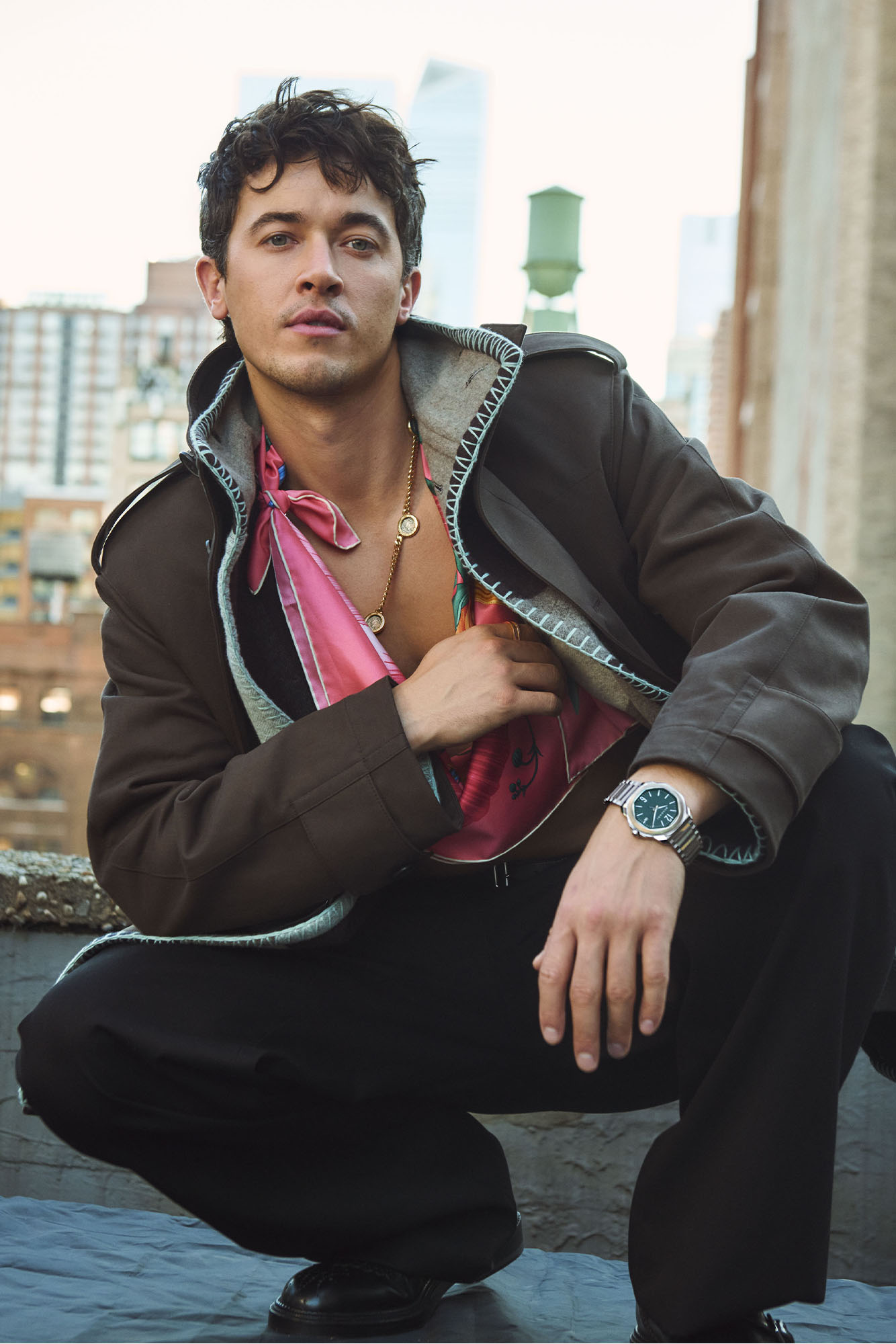
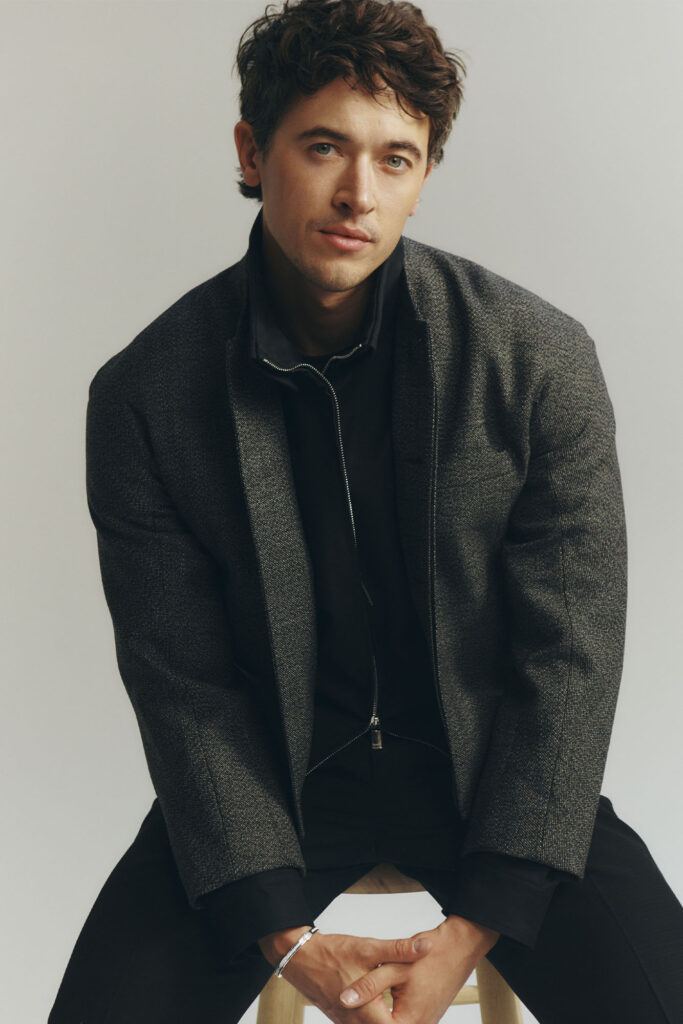
RIGHT: FULL LOOK BY HERMÈS; MONETE NECKLACE, B.ZERO1 RING, AND OCTO ROMA WATCH BY BVLGARI.
On the topic of getting into character, one of the things I’m intrigued by is the costume design: hair, wardrobe, all those things. Obviously, there’s a team who deals with that, but are you involved in those choices as well?
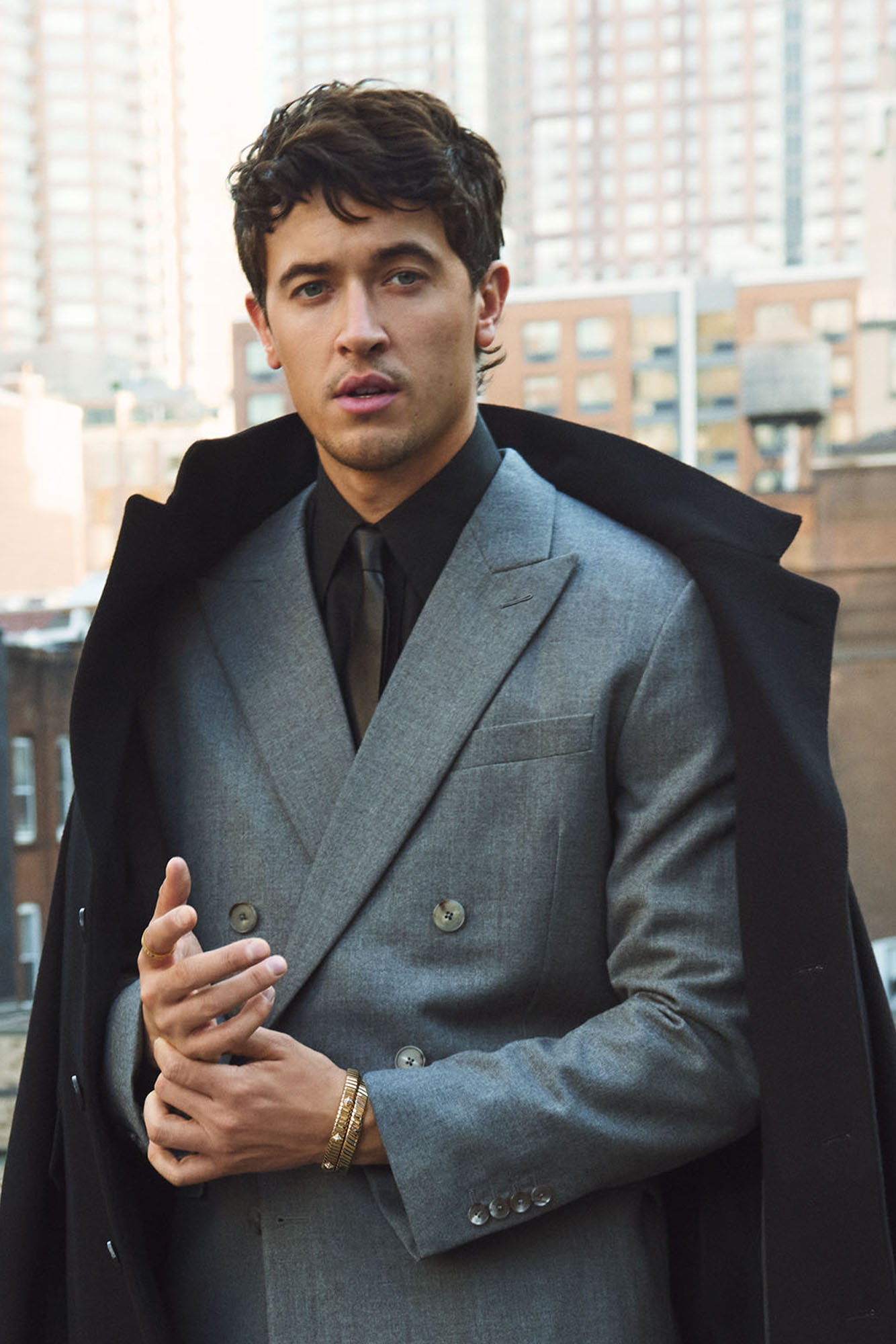
Yeah, that’s such a good question. I think that it should be a collaboration, when it works properly — and usually it does, in my experience. You get into the room with the costume designer, or even better, they’ll send ideas before you get there. They’ll send you sketches and say, “This is what I’m thinking. Do you have any thoughts?” Often, you’ll say, “Yeah, I love that, but maybe it’s like a darker colour, to capture that kind of darkness,” or “I was thinking more linens, more flowy material.” You have a bit of back and forth with the designer by email or text. Then, you’ll get there, and it becomes a real playtime. You get to try things on and test stuff out. Oftentimes, I’m in sync with the costume designer. We like the same things, we dislike the same things. If they’re good — which they usually are — they’ve read the script a bunch of times, just as you have, and they’re making well-educated decisions. I love that process: getting in the room, trying on different clothes and different materials. You think you’ve done a bunch of work, and then you try on the shoes and the trousers and the hat or whatever it is and, before you know it, you realize: “Oh, shit, there’s way more character stuff still to come that I hadn’t even found because I’m not wearing the clothes.”
It’s interesting to see how genre and tone vary from project to project: you’ve done fantasy, romantic comedy, thriller, drama. What lessons have you taken from your projects?
I love doing different genres because you learn so much. In Billy the Kid, I learned to horse ride and shoe guns and wrangle cattle — stuff that I would never have done otherwise. You literally learn new skills. An overarching thing I’ve learned is that if you go all in — believe in the character, what they need, and what they want — and everyone around you is doing that too, then no matter the genre, the process is similar. It doesn’t matter if it’s a big project, quote-unquote, a small film, big budget, small budget, sci-fi, action, drama… if everyone’s all in and you’ve got a director who has passion and a clear vision, then — no matter the genre, no matter the budget or scale — it just feels like filmmaking. I love that process. When it works, it feels like you tap into that childlike version of yourself where you’re playing make-believe. Except now, you’re doing it to try and bring it to other people, you know? Not just for yourself in your bedroom — you’re doing it to make other people tap into their imagination too.
When you decided to pursue acting as a career, was that how it felt? Like, “I want to do this; I want to play in these make-believe roles professionally.”
I loved film growing up. It was — I don’t know if I’d call it my safe space but, like, my comfortable place, my exciting place that I would go to. I can remember putting on, like, a VHS tape with Bedknobs and Broomsticks or one of those old films that I used to watch as a kid. It was always such an exciting thing. It was how me and my dad bonded, because he didn’t live with us — my dad and mum were separated from a young age, so I’d see him once a month — and we bonded and got to know each other through watching films. That was always a big part of my childhood. When I realized you could do it professionally for a living, I was just like, “Oh, I want to do that.” Like, if I could do the thing I love as an actual job, why would I not want to do that? I had a camcorder, like a lot of kids did. I would go outside with my stepbrother and my friends, and we’d make our own zombie films or little clips and then edit them together on whatever the equivalent of iMovie was back then, on the Windows computer. That was the first seedling of trying to do it — not professionally — but actually making something. That was probably when I was like nine or ten.

Recently, we’ve seen so many changes in the film industry: the rise of streaming, changes in consumption, different types of stories being made. Since you first began acting, how have you seen the medium change? What’s exciting about storytelling today?
Yeah… that’s actually a tough one. So much hasn’t changed, in a way, and yet a lot has. The very first film sets I went on, when I was like 11, 12, 13 — as like a glorified extra, trying to be an actor and auditioning for these things — they still look like the sets I go on today, as an actual professional — quote-unquote professional. I see so much that’s similar. Yet now, there are all these conversations around AI and how that may or may not change the industry and the jobs we do, which I think is scary. I think anyone who says [AI isn’t scary] is lying or they’re naïve. The idea that we’re going to replace what we do, which is such a human thing and such an exercise in empathy, with digitally-created versions of us — robots, things that don’t feel, that don’t empathize — how is that possible? I find that scary. I’m disappointed when I see people online talking about AI like it’s not a big deal. I’m like, “Oh, have you lost your humanity?” That’s the first thing I go to. I’m like, “What’s wrong with you?” We do this — we go to the cinema, we go to the theatre, we go to a museum, or we sit at home and watch TV and film — because we want to feel something made by other people who feel things. What’s the point in doing it if it’s an exercise between you and a piece of code? I don’t know. To me, it’s not the same thing. That’s sad stuff.
Anyway, that’s my TED Talk on AI. I don’t know if it’s fruitful. I think everyone’s waiting for the industry or the government to basically say whether AI is going to work and whether it’s a good idea. But I think, on a personal level, we all need to be checking in with ourselves and each other and saying, like, “Why do we make and view and consume art? Why do we do it? And do we really want to do it when it’s made by computers? Is there any point?” I think we need to start policing ourselves a little more instead of waiting for somebody to decide for us, you know? Like, actually check in with our humanity.
That’s a really interesting point. Any form of media is, like you said, an exercise in empathy; the core of it is about relating to another human through a story or an experience. As an actor, when you think about how the audience will respond to your work — it’s probably not something you think about when you’re on set — but after the fact, what is your hope for seeing how the work resonates with people?
I always hope that I make someone feel… recognized in their humanity. Even if you’re watching a big genre piece, or a sci-fi epic, or a Western, you’re still— when we watch something, we’re putting ourselves into it, I think. Every time I watch something and I enjoy it, I’m almost seeing myself as the protagonist, the antagonist, whoever we’re following. The people making it are using empathy, and the people viewing it are using empathy. I think that’s integral to a healthy, smooth society where we actually care about each other. It’s making us practice empathy, even from the comfort of our own homes. We’re watching stories and thinking, “How would I feel in that situation?” That is inherently what you’re doing when you’re watching a story unfold. So yeah, I hope it makes people feel human. I hope it makes them feel thrilled and excited, because I think that’s important too. And it depends what I’m doing; in the case of Plainclothes, I hope it makes people who are marginalized feel less marginalized, less like they’re in the shadows, because there’s a light shone on something that looks like their story. Sometimes it’s more for entertainment value, but I think always — no matter what, no matter how much entertainment it is — it’s still an act of trying to humanize people.
How has your passion for filmmaking evolved? Is the creative process something that you consciously think about outside of work — whether it’s reading plays or workshops or finding other outlets to keep that playful spirit alive?
I feel like I went through that this year, after having two really busy years — especially now, going into promoting films, which is a very different part of the job. I had a reckoning in the past year where I was like, “Do I still love this? Have I forgotten to ask myself why I’m doing it? Am I just on the treadmill?” You see people talk about getting on the treadmill and forgetting why they’re doing it, and I always thought, “Oh, I’ll never do that” — but you do. You can’t help but do it, when you’re in the trenches of it. Even just the act of asking yourself that question invigorates you again. It reminds you why you’re doing it, if you’re able to get the clarity to say, “Why do I still want to be doing this?” The fact that you’ve asked yourself the question and you’re still doing it means the answer is yes, most of the time. So yeah, I’m checking in with myself all the time, just to go: “Am I still doing this for the right reason? Am I still doing it because it ignites something in me — because I feel I need to do it — and not just because it’s the thing I found myself doing?”
I just did this music video with Paris Paloma; she came to me and asked me. She said she had this great song she was excited about, and she was envisioning me in the video with her. I thought about that, and I was like: “That’s why I do this — to get in the sandpit and play with someone, to tell a story in a different format, and to play in a format I’ve not really done before.” It’s a similar thing with producing. I’ve started executive producing things, and that uses a new muscle, which keeps it very fresh. Aside from just being an actor, you’re looking at the big picture and the general health and well-being of the project. You have your hands in the success of the project in a bigger way. So that’s something I’ve really enjoyed getting into and want to keep exploring. There’s a lot I haven’t discovered yet that I want to keep discovering.

It’s interesting to hear you talk about working with Paris Paloma on the music video; I was wondering — because acting is such a collaborative medium, it’s always about the chemistry between you and the people you’re acting alongside — are there certain collaborators who have made an impact on you or made you think about the process differently?
Working with Peter Dinklage on [The Ballad of Songbirds & Snakes] was definitely a career highlight so far. He’s so dexterous with the way he uses language, he’s so specific and unafraid to lean into the language. That was a reminder to me; there’s no shame in leaning in and enjoying the language you’re using. Sometimes, when I catch myself being a bit too casual with it or too modern with it — which is the contemporary way — I remind myself of what Peter does, and I’m like, “Don’t be afraid to really use the language.” If we want a casual conversation, we can go listen to one on the street — but on TV and film, it needs to mean something. So Peter and, more recently, David Jonsson. He has become a really close friend and collaborator. We did Wasteman together, and we’re looking at other things to do together. I love the way David… he’s just unafraid to go out and do it all. He’s putting his own film company together, he’s producing, he’s a writer, he’s an artist through and through. He’s a close friend and an inspiration to me. I think you look at your heroes and try to emulate the people you want to be like, right?
This transcript has been edited and condensed for length and clarity.
Direction & Photography: Rosaline Shahnavaz (Monday Artists)
Photo Assistants: Ivory Serra and John Ryan Gage
Production: Cole Stokley (Hyperion NY)
Lighting and Digital Tech: Isaac Rosenthal
DP: Isaac Rosenthal
Styling: Michael Fisher (The Wall Group)
Stylist Assistants: Bridget McDonald and Molly MacIntosh
Grooming: Melissa DeZarate (A-Frame Agency)