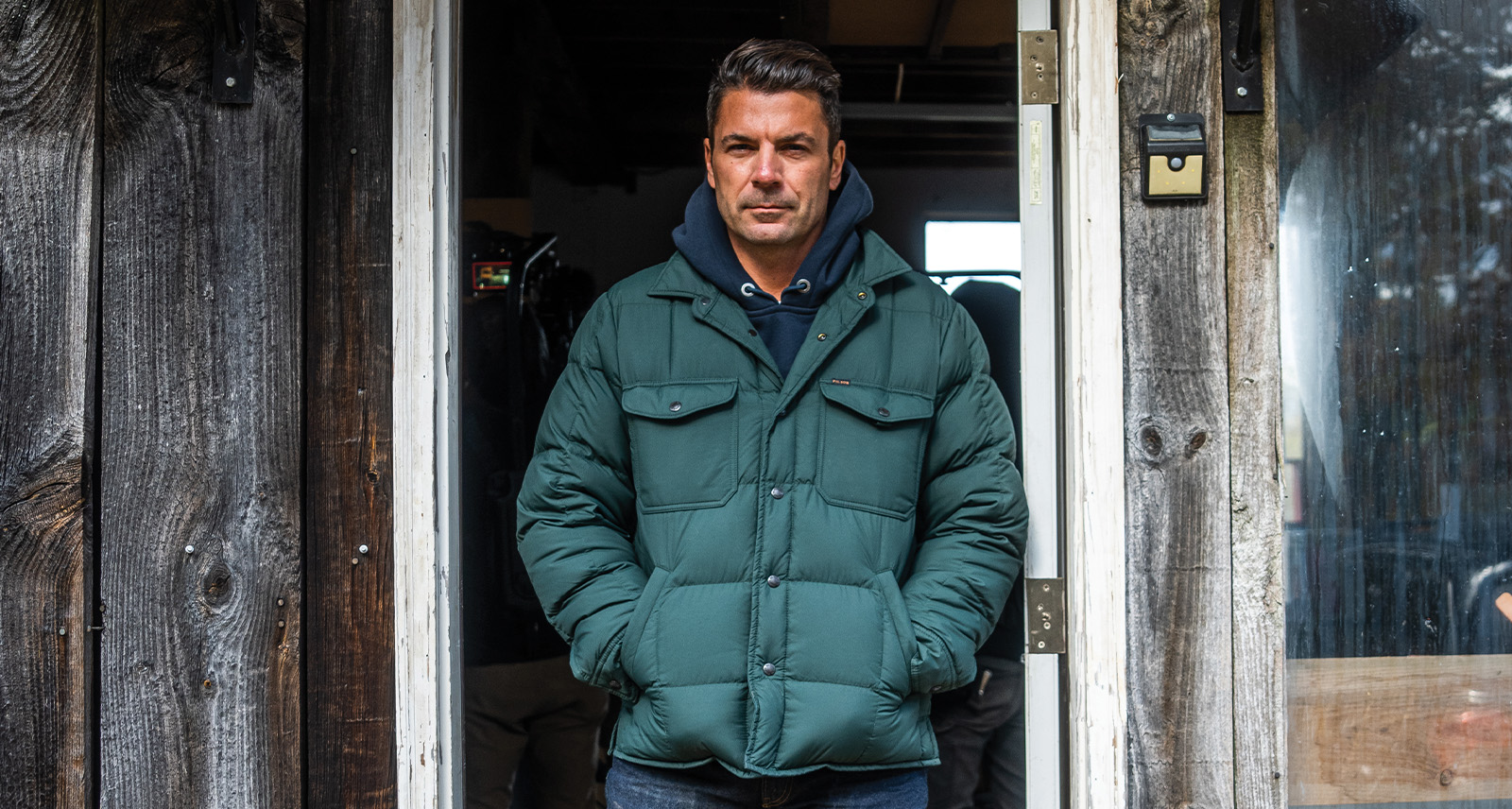
When Josh Rosen enters our call, he’s backdropped by an expansive grey sky and wind whistling in the background. The former pro snowboarder sits back idly in his chair, whittling a nondescript piece of wood with a knife. He’s dialled in from his property on the outskirts of Seattle, where he calls home with his family, a far cry from his days as the co-founder of Saturdays Surf NYC, Rosen’s former NYC-based lifestyle brand.
Within minutes of what was meant to be merely an introductory call, he sends us down a 45-minute rabbit hole discussing art, culture, food, travel, and fashion, with him posing most of the questions. It’s clear why Rosen was the perfect personality to launch DIRT, an internet travel show in which his curiosity takes him to all corners of the globe, joining local chefs to search for the unique ingredients and stories that set these regions apart.
“We’re not scouting places before and checking them out. We’re just going and hearing stories from these people.”
Josh Rosen
Finally, Rosen and I managed to get back on track to schedule a lengthier interview weeks later, following a DIRT production shoot in Japan, where we discussed the trip, the inception for his viral travel show, and where he hopes to find himself next.
You’re coming off a trip to Japan. When the show first started, you touched on a lot of regions in the United States. Since then, you’ve gone around the world. What goes into selecting the right locations for each show?
When we did the first episodes in the United States, we were dealing with a certain amount of history. So, you’re probably not going to have someone who’s a fifth generation of something, right? When you’re in the U.S., things are a bit newer and more entrepreneurial, I would say. And also, we’re growth based. Even when it’s small-scale, people tend to think big because as capitalists, our options are quite large. We can scale a business quickly. If your product is good and interesting, someone’s going to fund it. Whereas when you go to places like Japan with hundreds and hundreds of years of history, you’re dealing with someone who’s a seventh generation, eighth generation craftsman. So, that person is less concerned with growth and oftentimes is more interested in the evolution of the product and paying respect to what it is.


Do those differences change the way you’re engaging with the interviews or the message of the episode?
In that way, when you go to older places, you just sort of get a shift in energy. But you actually get this literal shift in texture, and you can really see the history. We were in a 300-year-old saké distillery, which is steaming all the time because they’re reducing the liquid down. So, this whole place had been steamed for 300 years, and the colours, you just can’t replicate it. Oftentimes, then the people’s energy reflects that as well. […] When we visit places now, I’m more enlightened to the idea that if you’re going to a place with a really long history, you’re going to get a different experience compared to a much younger region.
DIRT has evolved so much since it first launched in 2022 but through every iteration, it’s always seemed like such a dream role for you. What was the inception?
When I met Kate West, my director, co-creator, producer — she wears many hats — and we started talking about the concept, we had this moment of endless energy and creativity and excitement. I have similar energy when it comes to research and bringing people together to make something happen, right? You need two pieces of the machine, the two cogs, to make it work. She pitched the show and then we were off and running. It really was a nice culmination of those two energies together to create DIRT.
On the Road: A Conversation With”DIRT” Host Josh Rosen
PHOTO COURTESY OF “DIRT”/HUCKBERRY.

On the Road: A Conversation With”DIRT” Host Josh Rosen
PHOTO COURTESY OF “DIRT”/HUCKBERRY.
You have such an eclectic career, from pro snowboarding to fashion entrepreneur. Why did you feel like you’d be the right fit for the host of a travel show?
A lot of DIRT is the way I engage with the world. So, if we’re by a body of water, I’m going in, or if there’s a mountain, I’m going to try to climb it, right? […] That’s just the manner in which I live and have always lived. It’s curiosity. I’d worked on little pieces of [the show] here and there, but I’d never actually formulated it. And part of that is because I’m very visual and I can be easily distracted. So, in making a TV show, someone’s got to be really focused on details. That’s where the rest of the team came in.
“The show is told through the joy of experience and adventure and curiosity, as opposed to focusing on the doom and gloom of the world. But there’s also a great amount of truth in speaking to people about their lived experiences.”
Josh Rosen
Did bringing other people aboard the production team shift your concept of the show?
It’s helpful when you’re a bit older because you’ve been through the process a bunch of times, so you know [that] you have to be open to your idea being something else. For me, I had this idea of a show which was more geared towards [snowboarding and surfing] and engaging with communities that lived around waves, mountains, and rivers […] and then the food and the experiences that those guys people were having. What Kate brought was more of an element of culture. She said, ‘You know, there [are] places that we can go that we can pull apart the preconceived ideas behind. We’ll meet the people and get story and perspective from them.’ The adventure is what we do with those people in those stops. And that works really well with me because, when I’m traveling, I’m often looking for the amazing parts.


Food is obviously such a core part of the show. Has DIRT changed your diet or relationship with food outside of shooting?
I think that my excitement about trying food has only expanded. My dad’s thing was always, ‘Can you eat it?’ We’d go to tide pools at the coast and they’d be full of creatures. Our neighbour was a marine biologist, and he would often be there with us. I spent my childhood trying all sorts of things out of the out in the world. […] If anything, I think I’ve learned more about where things start. Terroir is this very important word for us because it is the connection [between] the environment and what’s being produced. So, if you’re an oyster farmer in Washington State, the mountainside where the water is filtering down and picking up minerals and putting it into the bay where the oysters are growing, you have to know exactly what’s on that land because [it’s] directly connected to the oysters that you’re giving to someone. That’s what we initially did — we were like, ‘Okay, you go to a restaurant, you get a plate of food. Well, where did each of these things come from?’ So, we go to those places and we meet those people.
“[DIRT] is not polarized like a lot of other media. There’s no agenda. It’s about asking questions to people who are connected to the land, the ingredients, the everyday effects, and learning from them. You’re going to hear firsthand — not from me — but from people actually living in these spaces.”
Josh Rosen
What sets it apart from other travel shows?
We’re not scouting places before and checking them out. We’re just going and hearing stories from these people. And it’s not always the most beautiful place. We’re not always going in spring or in the summertime. We’re visiting farmers in the dead of winter, which is usually a really quiet time. We learned that there’s an old practice in Japan where one would bury cabbage in snow because it [was] cheaper than buying a refrigerator. When they dug it up, they found it was incredibly crisp and sweet. The sugars had condensed and were amazing. I mean, let me tell you, if you try this cabbage, wow. […] But it’s pieces like that, right? We’re discovering stories that exist in places that other people visit, but what else is there outside of those places? What happens in the village next to that? Hopefully, we’re telling a more holistic story of a place because we’re going and reaching out to zones [where] the story hasn’t necessarily been told.
I also hope people would be happy to know that this is 100 percent unscripted, real television. I’ll usually stay in the truck while the camera guys are getting everything ready and then I’ll go and meet the person we’re interviewing because I really want it to be a genuine experience. […] One of the things we get a lot is that [the show] reminds people that engaging not only with the place but with the people in that place allows them a deeper human experience.

Why does now feel like an important time to produce a show like this?
It goes to the source to ask the questions. The show is told through the joy of experience and adventure and curiosity, as opposed to focusing on the doom and gloom of the world. But there’s also a great amount of truth in speaking to people about their lived experiences. You learn about the real factors that are harming us. It’s not polarized like a lot of other media. There’s no agenda. It’s about asking questions to people who are connected to the land, the ingredients, the everyday effects, and learning from them. You’re going to hear firsthand — not from me — but from people actually living in these spaces. They’re imparting their knowledge and I’m just there to hold the conversation and help guide the experience. The audience can just take what they choose from each episode and do what they will with it.
What’s next for the team?
We have such an exciting year of locations planned. I think the Middle East has some really interesting places that could use some positive light and experiences shown outside of what we’re usually shown. But otherwise, we’re just looking forward to sharing experiences from near and far.
This article has been edited and condensed for clarity.
DIRT is available to watch on huckberry.com.