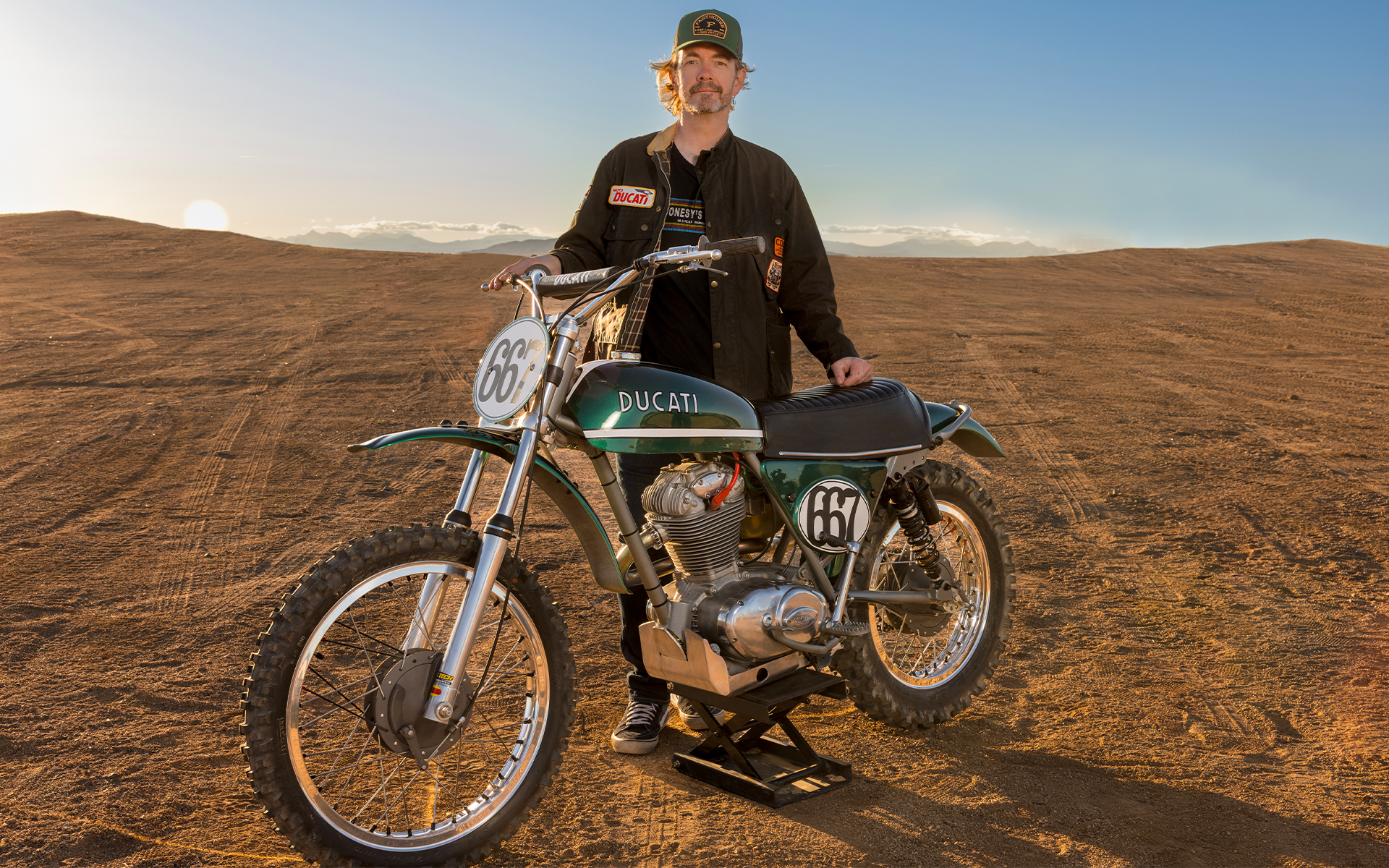
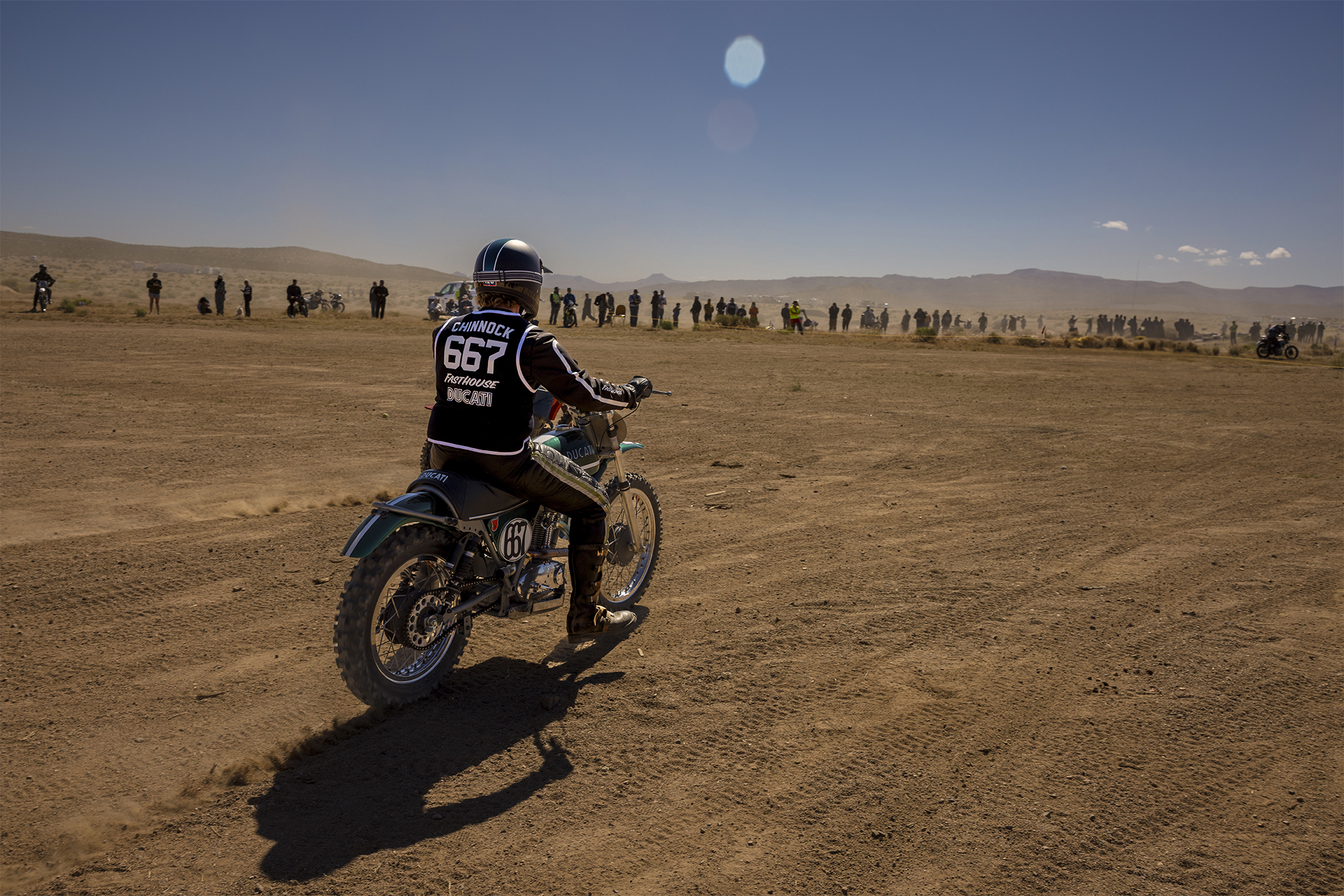
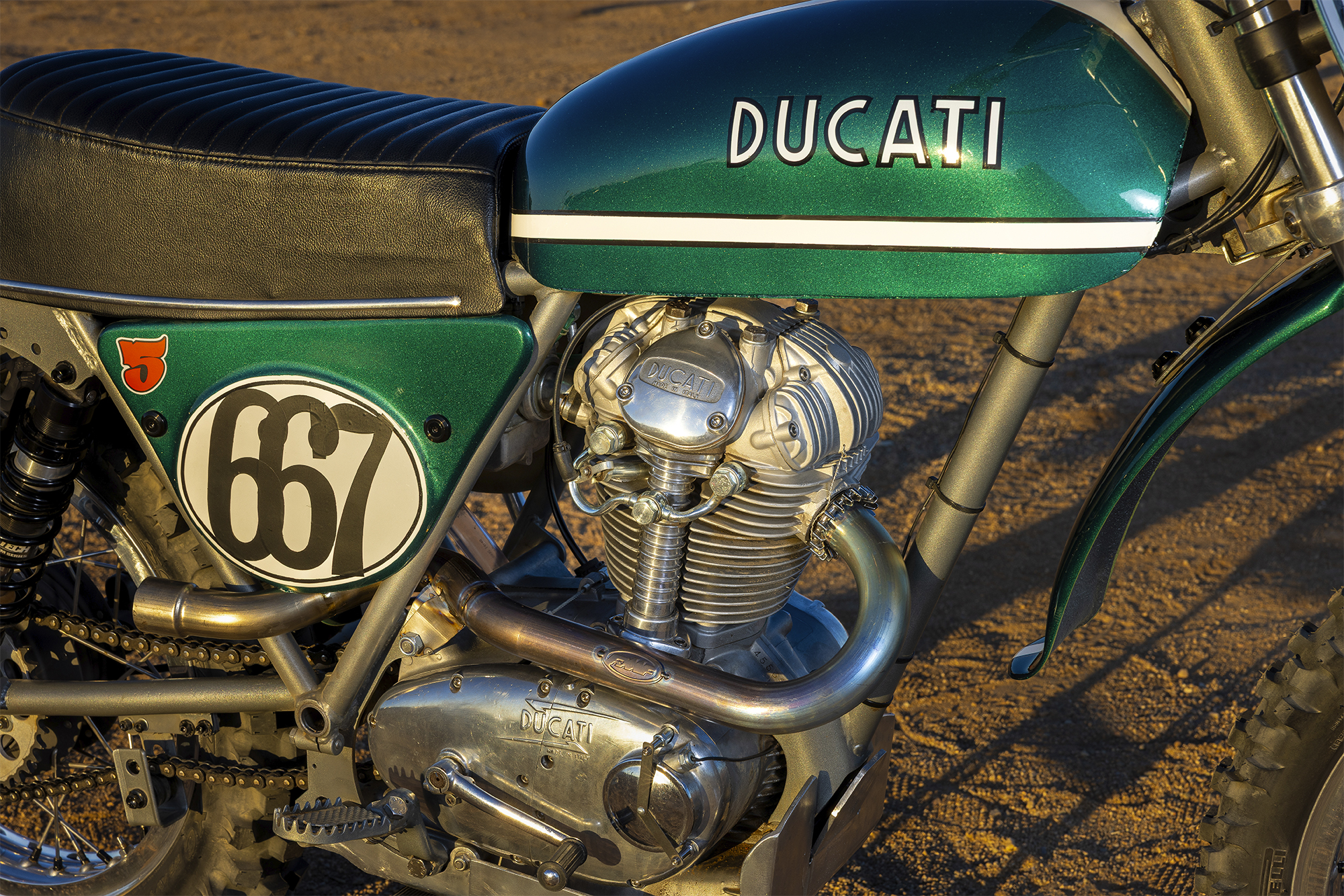
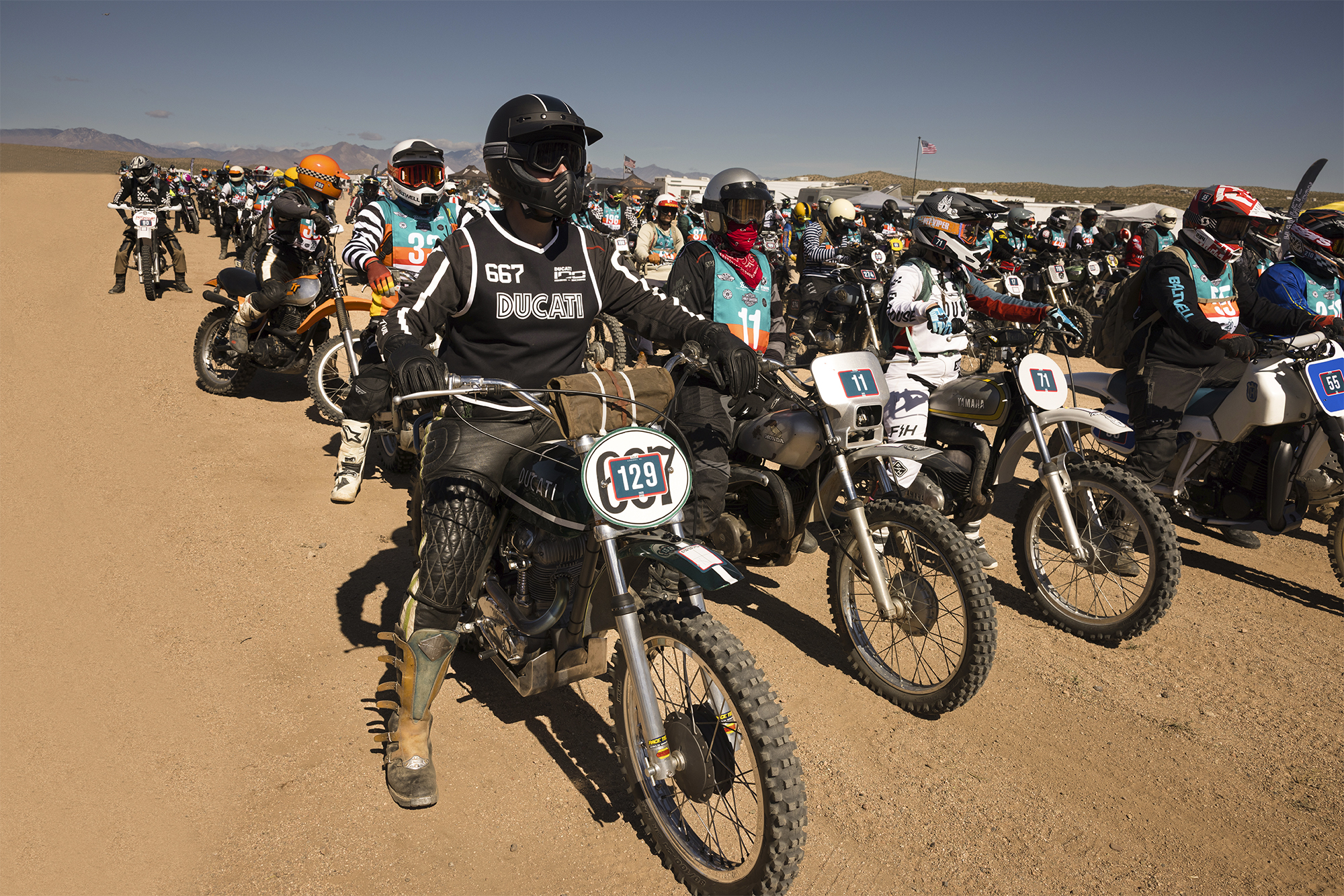
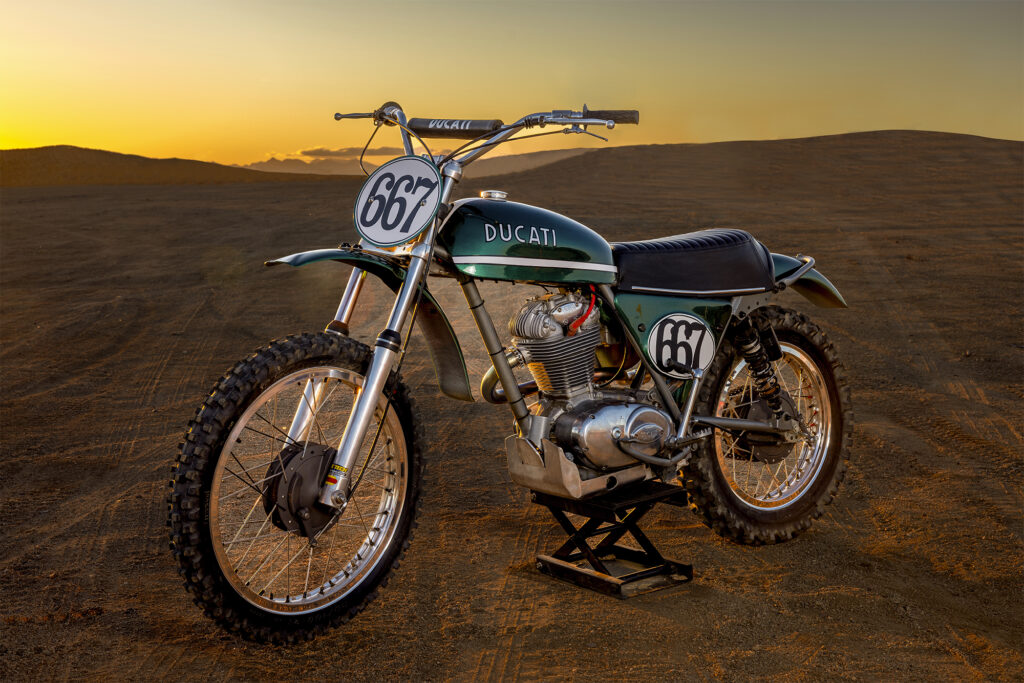
Catching up with one of the most genuinely moto-obsessed CEOs in the motorcycle biz is always a good time, and chatting about vintage Ducati dirt-bikes is even better. Jason Chinnock, head honcho at Ducati North America, recently got to live out a dream of ours by racing the Biltwell 100 on a beautiful 1971 Ducati 450 R/T that he painstakingly restored and modified himself. (Yes, the Italians over at Ducati do more than just make blood-red road missiles, you know.) The Biltwell race is, as its slogan says, all about good times and not lap times — but that doesn’t mean it’s easy. Far from it.
We spoke with Chinnock after his first race on the ‘71 Ducati 450 to talk dirt-bikes, Ducati history, getting your hands dirty, and then made him answer questions about our wish list for future Ducati motorcycles.
SHARP: How did motorcycling first get under your skin?
Jason Chinnock: I’m a child of the ’70s. Motorcycling came onto my radar during Evel Knievel’s career, growing up in Las Vegas. There’s the famous jump of the Caesars Palace fountains that he had done back then. From there, it’s BMX. My parents wouldn’t let me have a motorcycle, which made it all the more attractive and exciting. So I would sneak over to my friend’s house and run around the desert on a YZ80 Yamaha and just got bit by the bug at a really, really young age.
You recently restored and raced a 1971 Ducati 450 R/T. It’s a deep cut in Ducati’s catalogue. So how did that bike end up in your garage?
I went to an event in Southern California over Thanksgiving called Day in the Dirt. In the evening, they had this race with a club of guys riding vintage bikes. I thought, ‘That looks like a lot of fun, but I can’t go out there on anything but a Ducati.’
I started doing some homework. Ducati had built — it’s one of those things that was a blip in our history — a dirt-bike purposely designed for the American market. In 1969, a couple of guys went out on a highly modified Ducati Scrambler 350 and won the very first Baja 500. That inspired the importer, Berliner, to go to Ducati and say, ‘Hey, we need a purpose-built dirt-bike.’ That’s when this bike [the ‘71 Ducati 450 R/T] came about. They’re fairly rare. When I found one in January, I’m like, ‘Okay, this is a sign.’ Bought it immediately.
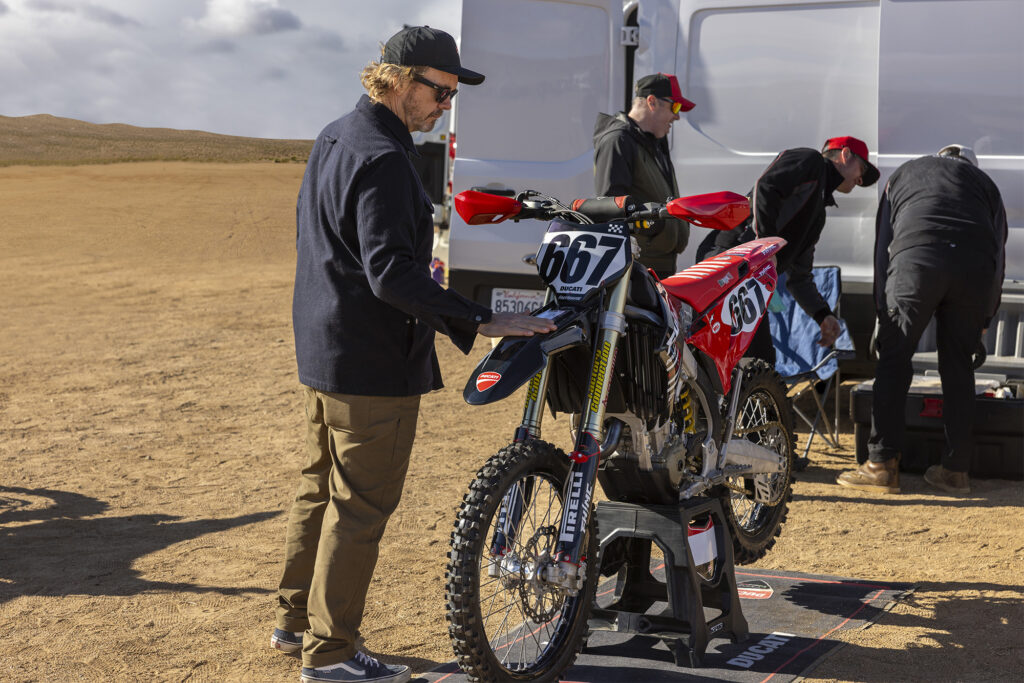
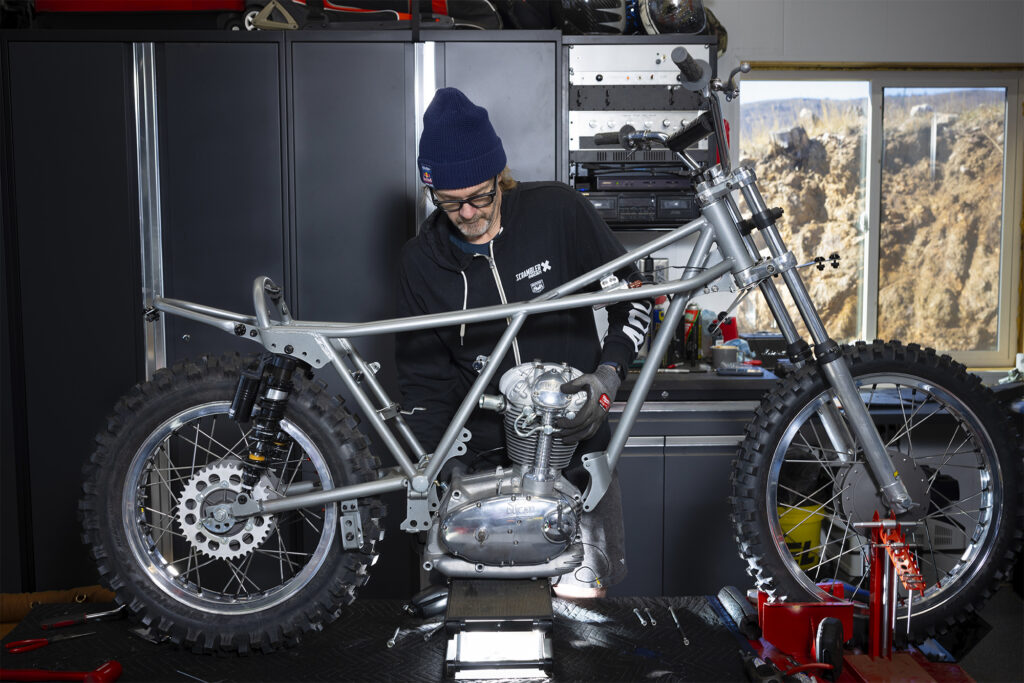
Restoring a rare 50+ year old Italian motorcycle is not for the faint of heart (or wrench). How much time, money and sweat did you put in?
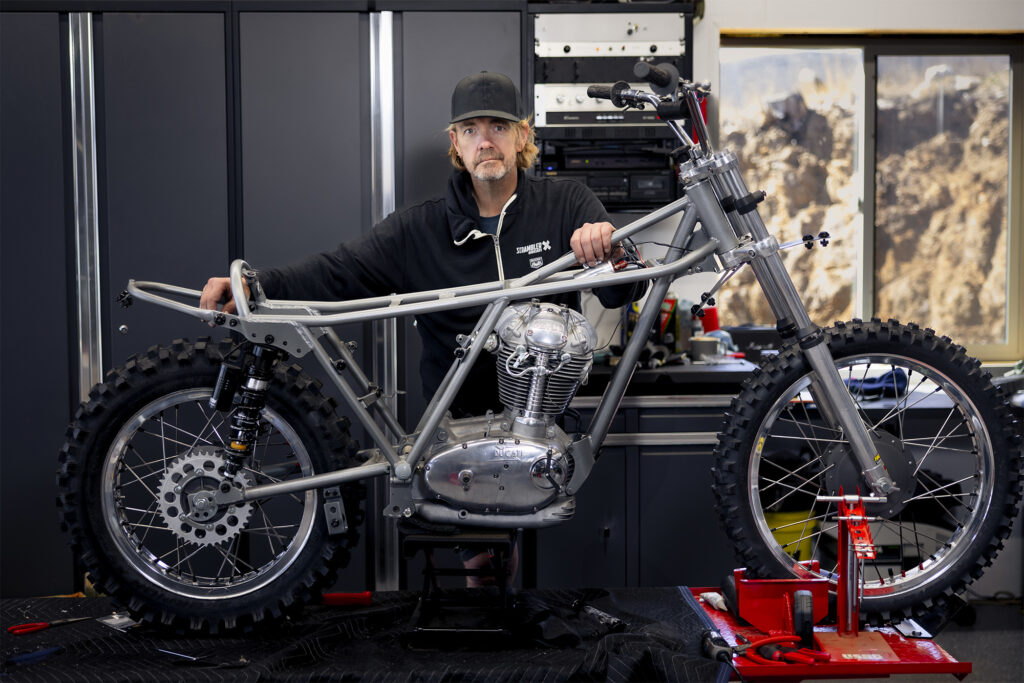
It was all out of pocket. I started with a budget. Then you start getting budget creep, and then you just realize that there is no budget. You stop counting. Easily 400 hours on it. I stripped everything down. The only things I handed over to anybody else were stuff beyond my skill set: I shipped a motor to a friend in Florida who does engine restorations, and I handed the frame to a powder coater. Everything else, every bolt, every bearing, nothing was left untouched. Money-wise, easily 20 grand.
I rolled everything into the trailer at four in the morning, slept till seven, then got on the road at eight for the 16-hour drive out to the middle of nowhere, California. The first time I rode it was at the race.
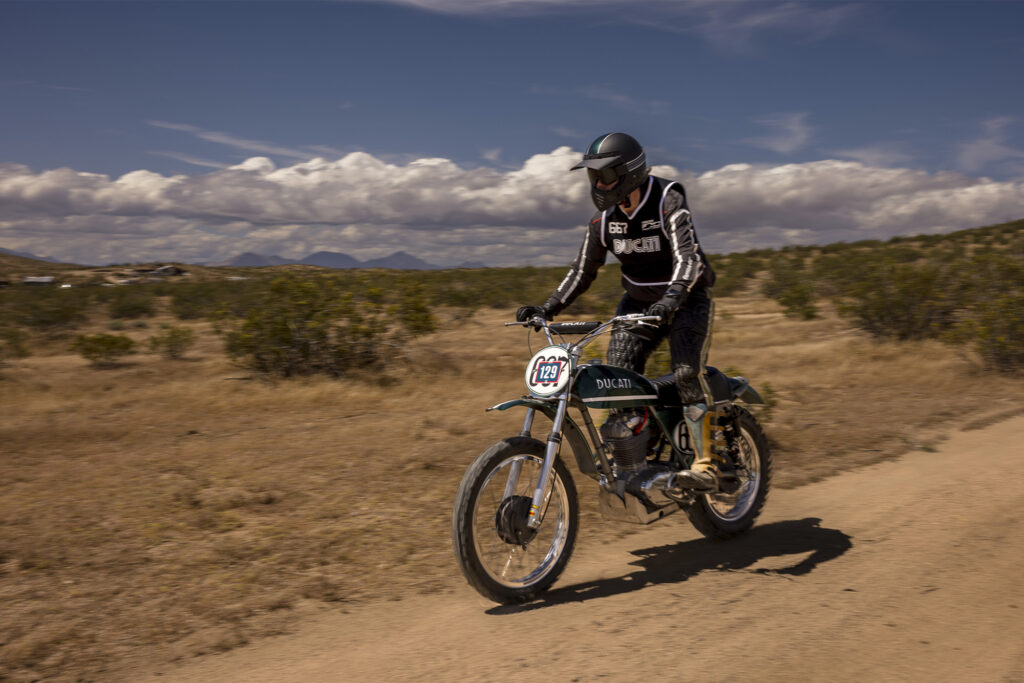
What’s it like riding a 54-year-old race bike?
The last stroke of suspension is your spine. I had to relearn my riding style. On a modern off-road bike, you’re rarely in the seat. Here, you’re sitting on the cushy seat a lot, because the bike moves around so much you need your weight on it for it to be planted. At one point I fouled a plug because I was in deep sand and bogged the motor. I pulled over, swapped the plug out for a spare, kicked it and just went back out.
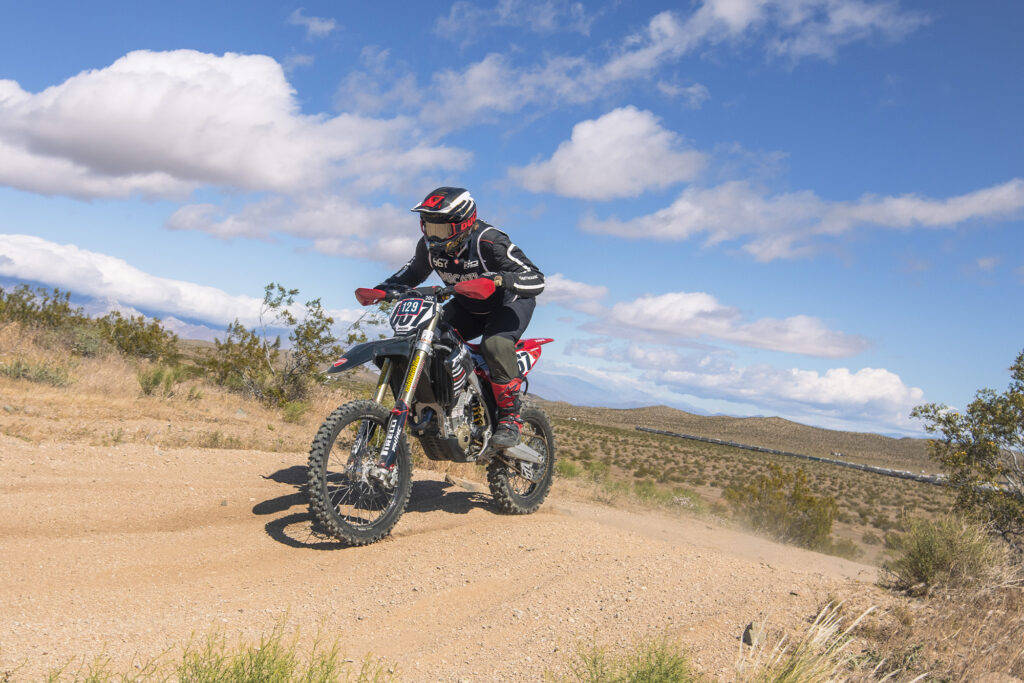
How did the vintage bike compare to the new Ducati Desmo450 EDX you raced the next day?
Competitively, the [450 EDX] was like a magic carpet. It felt so good and so confident, because I knew the course, and now I’m on something that’s light-years ahead. That’s 54 years of development of off-road motorcycles! There are characteristics Ducati has that bridge that 50 year gap though, and that’s a really difficult thing to explain, but I had the same emotional connection riding both the motorcycles.
For readers who don’t know motocross or the off-road scene, what’s the vibe like?
They’re passionate. It’s very family- and community-oriented. It’s approachable. It’s affordable. It makes motorcycling accessible. At a race like Day in the Dirt, people rent an RV and camp for the entire weekend. It’s as much about what happens off the bike: sitting around the fire, bench racing, sharing stories.
Most people’s first motorcycling experience in North America is on the dirt. That’s very different from European riders, whose first experience is usually a scooter or an on-road motorcycle. People think American motorcycling is cruisers. The reality is it’s off-road; you’re connecting with people’s first emotional experience with the motorcycle.
Ducati has launched a range of new off-road motorcycles, but it’s a scene long dominated by brands like KTM, Honda and Yamaha. How challenging has it been for Ducati entering that market, with the new Desmo450 dirt-bike?
That’s a great question. I was asking myself that. If we’d just come out with a bike, off-road people would have patted us on the head. But when we said we’re also coming racing at the highest levels in North America, Supercross, Motocross, it was like, ‘Oh wait, Ducati, you guys are the ones winning MotoGP.’ They recognize we’re bringing this level of tech and they’re stoked. There are always going to be haters, and that’s fine. But so many people are seeing it’s for the greater good of the sport.
We’ve got to ask about what’s next for Ducati. First a selfish one: Because we’re big fans of the single-cylinder Hypermotard 698 Mono, will the 698 engine end up in any other bikes?
At this time, it’s not planned. I’ll be candid; I’m in the product development meetings, and we’ve thrown a lot of ideas around. That 698 mono is a spectacular motor. We’ve seen a trend in North America for lower-displacement motorcycles. Not everyone wants 200-plus horsepower. I’d be remiss to speculate, but you can imagine where I’d like to see that [698 engine] go.
Any chance of a new lightweight dual-sport from Ducati, or a revival of the Scrambler Desert Sled?
You’re tugging at my heart strings. I’ve got a Scrambler Desert Sled in my garage. The challenge is the retro-inspired market has gone down-market. Look at models like the Royal Enfield. It’s a $8,000 bike. For what it is, it’s great, but we can’t build a $7,000 bike. For us to build a new Desert Sled, it would land around $14,000 to $15,000 Canadian. It would need a new frame, a new swingarm; it’s not just putting different wheels on a Scrambler. It’s a challenge, but it doesn’t mean it’s impossible. But I promise, I make it a point every product meeting. I’m always pushing for this. I’ll carry the flag until I’m told to stop.