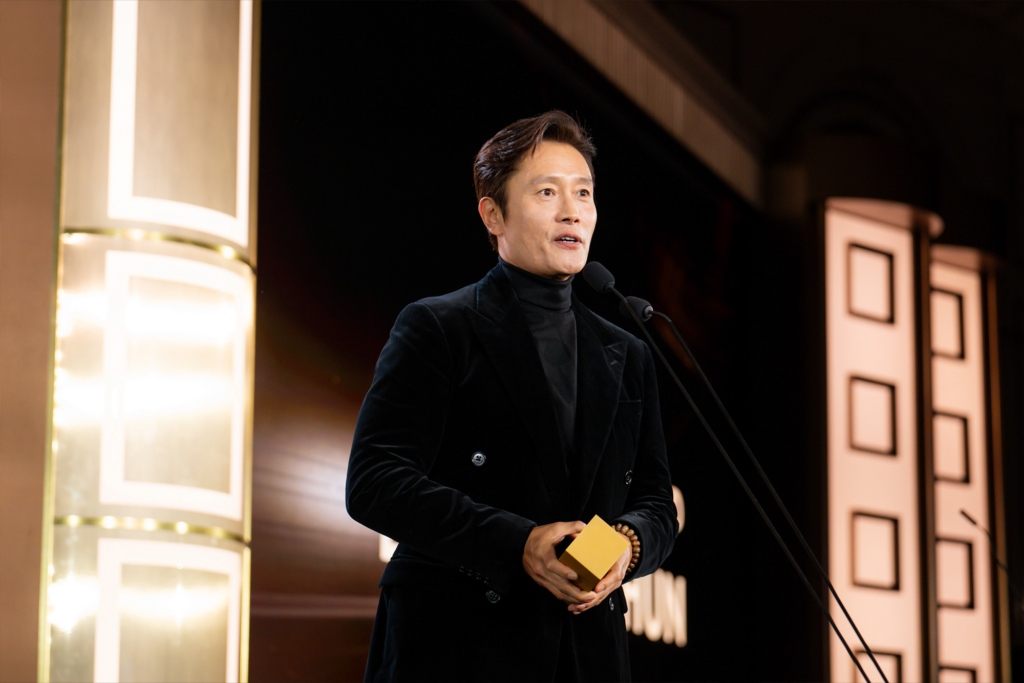
As the 2025-2026 awards season heats up, director Park Chan-wook and actor Lee Byung-hun find themselves at the centre of a global whirlwind. Their latest collaboration, No Other Choice, has not only secured a coveted spot on the Oscar shortlist for Best International Feature Film but has also swept into the Golden Globes with nominations for Best Motion Picture (Musical or Comedy) and Best Actor for Lee — it made history as the first Korean title ever nominated for a Golden Globe for Best Motion Picture. It also earned a People’s Choice Award win at TIFF.
What is it about this dark, violent and surprisingly funny tale of a laid-off paper industry worker that is resonating so deeply with critics and voters alike? According to the creators, the answer lies in the intersection of pathetic desperation and universal empathy.

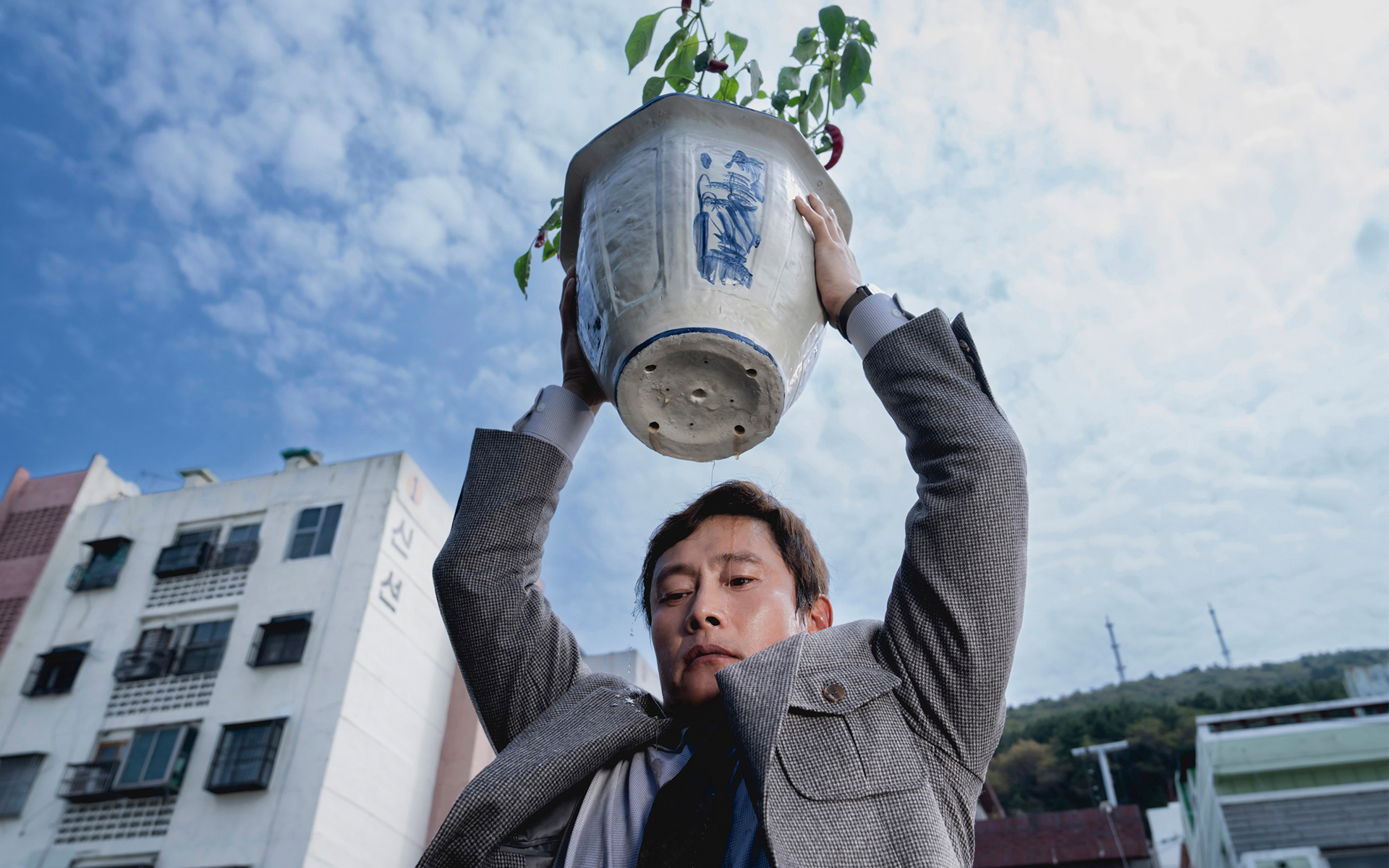
No Other Choice, in theatres on Christmas, follows Yoo Man-su (Lee Byung-hun), a middle-aged paper industry expert who, after being discarded by his company of 25 years, launches a desperate, murderous plot to eliminate his job-market competition when a new position finally opens up at a company.
For director Park Chan-wook, the heart of the film isn’t just the body count — it’s the “hapless” humor found in Man-su’s incompetence. “Comedy comes from how foolish his decisions were and how hapless he was in the execution of those decisions,” Park explained in an interview. “I wanted to emphasize both of those elements to the audience, and humour was an important tool in order to make that happen…I think the laughter really comes from how pathetic his words are, but also from the sympathy for the character as well. I think both of them go hand in hand.”
Lee Byung-hun, known for his stoic intensity, leans heavily into his comedic timing. He even contributed several improvised moments to the final cut, including a scene where Man-su, exhausted from trying to bury a body, falls asleep and wakes up to a police questioning intended for his son and he almost confesses to his own crimes.
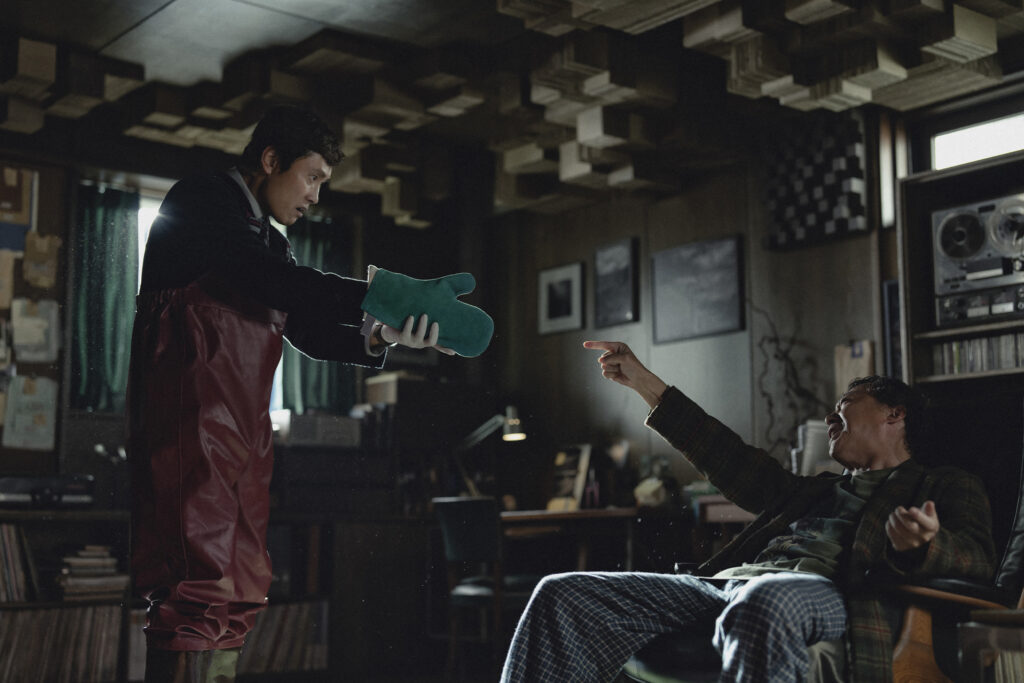
“Even though I haven’t been able to show you a lot within this genre, [black comedy] is something that I love a lot,” says Lee. “I really love exploring really dark aspects of the story that have a lot of irony.”
The film’s tone is perhaps best summarized by a standout music room scene that Lee himself blocked. In it, three characters struggle on the floor to reach a dropped gun, moving “almost like worms” to reach under a cabinet.
This physical vulnerability extends to Man-su’s many nervous tics: shaking legs, fidgeting hands and a persistent, stress-induced toothache. Lee notes that while many of these were in the script, they emerged organically through the character’s “mental and emotional breakdown.”
It’s easy to empathize with a Korean paper-mill worker whose identity is tethered to his job. Director Park believes the film taps into a universal fear of “worthlessness” in a capitalist system and reckons the movie industry to the paper industry.
“One day, if I’m not healthy anymore, so I can’t make films, or I lose my reputation, and I can no longer find investments for my future movies, I feel like my life would be shattered […] In order to prevent that from happening, I think I need to find ways to fulfill my sense of identity, beyond my identity as a filmmaker or just my job.”Park Chan-wook
“Movies might be similar [to paper],” Park observes. “There are great movies that people do value, but I think that’s pretty rare, and most of the time, people just consider movies as a two-hour source of entertainment, just to waste time. They might not value film or filmmakers as much, but to us who make films for a living, films really mean everything.”
He continued: “One day, if I’m not healthy anymore, so I can’t make films, or I lose my reputation, and I can no longer find investments for my future movies, I feel like my life would be shattered, and I would be in the state of great devastation, just like Man-su are in the movie. So in order to prevent that from happening, I think I need to find ways to fulfill my sense of identity, beyond my identity as a filmmaker or just my job.”
The secret weapon of the film is the 25-year shorthand between Park and Lee. Their partnership is built on constant communication and a shared sense of humor that often bleeds into the script. Park describes their time on set not as work, but as an “endless experience of having conversations because he’s such a witty storyteller.”
“There is a sense of universality that goes beyond just what contemporary audiences in Korea would be able to understand and appreciate. So, there’s a higher possibility that even 50 or 100 years from now on, this film would still have meaning to the audience.”Park Chan-wook
Park added. “He’s a very funny person. He’s very creative and is very quick on his feet… he has great ideas on the spot when we’re on set.”
This back-and-forth allowed the film to find its unique “heartbreaking-but-funny” tone. Park admits that as a director, the experience of listening to Lee’s ideas and expanding on them was deeply fulfilling: “Only if you’re able to enjoy this process can you truly call yourself a director for Lee Byung-hun.”
The global resonance of No Other Choice stems from its ability to hold up a mirror to universal anxieties. Lee Byung-hun, who has bridged the gap between Seoul and Hollywood for decades, attributes this global reach to the “unpredictability of the storylines.”
He notes that his American friends and colleagues are consistently drawn to the way Korean films blend genres, shifting from slapstick to horror to social commentary in a single breath. “Korean storytellers are really able to create stories that people can empathize with globally, regardless of culture or language,” Lee says.
“I really wanted to be a part of something that my kids could watch. I really didn’t imagine that it would be a project that so many people love so much.”Lee Byung-hun
Park added: “To have the opportunity to present my film to people around the world is extremely important to me. In addition to that, if the film is well received abroad, that’s also extremely meaningful, because I think how this film is received abroad will also reflect how this film will be received in the future, in general, because the fact that audiences outside of Korea are able to empathize and respond positively to the film means that there is a sense of universality that goes beyond just what contemporary audiences in Korea would be able to understand and appreciate. So, there’s a higher possibility that even 50 or 100 years from now on, this film would still have meaning to the audience. That’s also very important to me.”
Korean cinema is thriving in Hollywood and it’s not just this title. Another Korean entry that is making waves this awards season is animated hit KPop Demon Hunters on Netflix, which also features Lee Byung-hun, who surprised fans this year by voicing the villainous Demon King (Gwi-Ma) in the, a role he took for a surprisingly personal reason.
“I really wanted to make something that I could watch with my kids,” Lee shared. “A lot of my filmography can be violent, so I really wanted to be a part of something that my kids could watch. I really didn’t imagine that it would be a project that so many people love so much.”
The unstoppable momentum of No Other Choice and K-Pop Demon Hunters signals a permanent shift in the cinematic landscape, where “foreign” films are no longer relegated to the sidelines but are leading the pack. By weaving together the thrills that have made Korean content a global obsession with a deeply human story, Park Chan-wook and Lee Byung-hun have created something that elevates storytelling. There’s no doubt this film will also land prestigious Oscar nods, too.
No Other Choice is in theatres on Christmas.
FEATURE PHOTO COURTESY OF ELEVATION PICTURES.