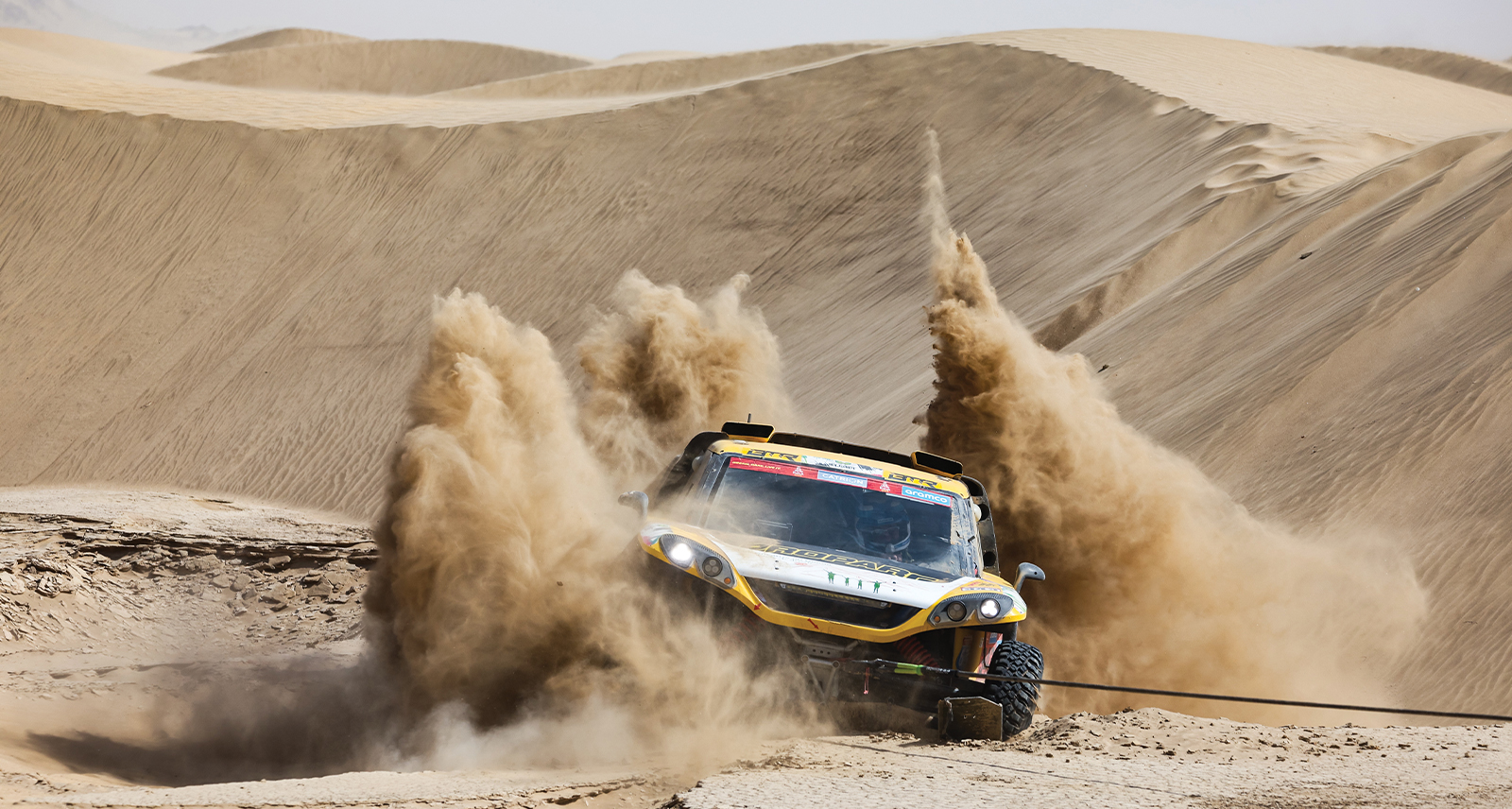
If you wanted to come up with an idea for a race that would push the world’s best rally drivers and the world’s most rugged off-road vehicles to their limits, it would be hard to come up with something more punishing than the Dakar Rally. Set in the Rub’ al Khali, an uninhabited region of the Arabian Peninsula whose name translates literally to “the empty quarter,” the two-week race pits drivers against each other and the elements in one of the most insane spectacles of organized motorsports ever conceived. There are no roads, the temperatures are scorching in the daytime and freezing at night, and everything is covered in a fine layer of sand and grit. Vehicles regularly flip, crash, and get stuck. Occasionally one catches fire. In short, it’s the kind of thing rally fanatics dream about.
“At an F1 race the conversation is really around picking up tenths of a second wherever you can,” explains Cole Pennington, communications officer for Swiss luxury watch brand Tudor, the event’s recently inaugurated official timekeeper. “At Dakar, every single driver will say they would be ecstatic just to not drop out of the race. The worst enemy in Dakar is not necessarily your opponent or your fellow competitors, it’s the landscape.”


Fittingly for a race set in one of the most inhospitable locations on earth, the Dakar Rally began with a near-death experience. In 1975, while competing in the “Rallye Côte-Côte” between Abidjan, Côte d’Ivoire, and Nice, France, motorcycle racer Thierry Sabine got lost in the Ténéré desert, a 400,000-squarekilometre wasteland in the southern Sahara. After two days of wandering the dunes without water or a compass, Sabine was spotted by a rescue helicopter. Not only was he undeterred by the experience, it inspired him to create a new race, a 10,000-kilometre odyssey through Algeria, Niger, Mali, and Senegal the next year. That’s how the Paris-Dakar Rally was born. Over the next few decades, the race format would evolve and the location would change several times, decamping throughout Africa and South America before settling into its current home, Saudi Arabia, in 2020.
Taking place over 8,000 kilometres and a dozen day-long stages, this year’s race saw 335 vehicles representing 52 nationalities at the starting line, ranging from specially tuned off-road bikes and rally cars to semi-trucks. While the field is dominated by factory team vehicles purpose-built to handle the desert’s rough terrain, those who don’t find that challenging enough can enter the Dakar Classic, a category whose entrants range from vintage Toyota Land Cruisers and Tuthill Porsche 911s to two-wheel-drive Citroën 2CVs.

Five minutes before the start of each stage, drivers and navigators are provided with a digital route book for their GPS, and each team must blaze its own course through the desert, navigating around rocks, sheer cliffs, and steep dunes. With no roads or markers to follow, drivers must keep a close eye on their mileage, interpreting directions like “Take a right at the rock in 0.2 kilometres,” and “Exit sand wash, left at tree,” all while driving flat-out across uneven, unfamiliar terrain. “It’s man versus nature,” Pennington says. “Sand is a constant, but the landscape itself is actually very different throughout different stages of the race. There’s one later stage where the landscape is just otherworldly dunes, and the first Bisha stage has a completely different look, with more brush and palm trees.”
The variability of the terrain keeps things interesting for drivers and guarantees at least one major upset each year. This year’s race saw Carlos Sainz Sr., a Dakar veteran and the father of F1 champion Carlos Sainz Jr., flip his Ford Raptor T1+ car on a dune, cracking the roll cage and disqualifying his team from completing the race. Nine-time World Rally champion Sébastien Loeb suffered a similar incident and was likewise forced to withdraw. At the end of the final stage, the motley crew of dusty, battered, and ecstatic drivers who took the podium included an Australian dirt bike pro, a Saudi banking magnate turned rally champion, and an Argentine husband and wife team. Despite the celebrations and medals, the winner’s circle was somewhat anticlimactic — and not just because Saudi Arabian law forbids the conventional champagne shower.


“Most people couldn’t even tell you who won,” Pennington says. “You could look it up, but it’s not so much about personalities as other races, and that’s what makes it interesting to Tudor — it’s truly ‘Born to Dare.’ Part of the Dakar indoctrination is understanding that if you’re out there, you made a lot of sacrifices to be out there, and you want to feel the pain a little bit. That’s the kind of event that it is.”
Photos courtesy of Tudor.