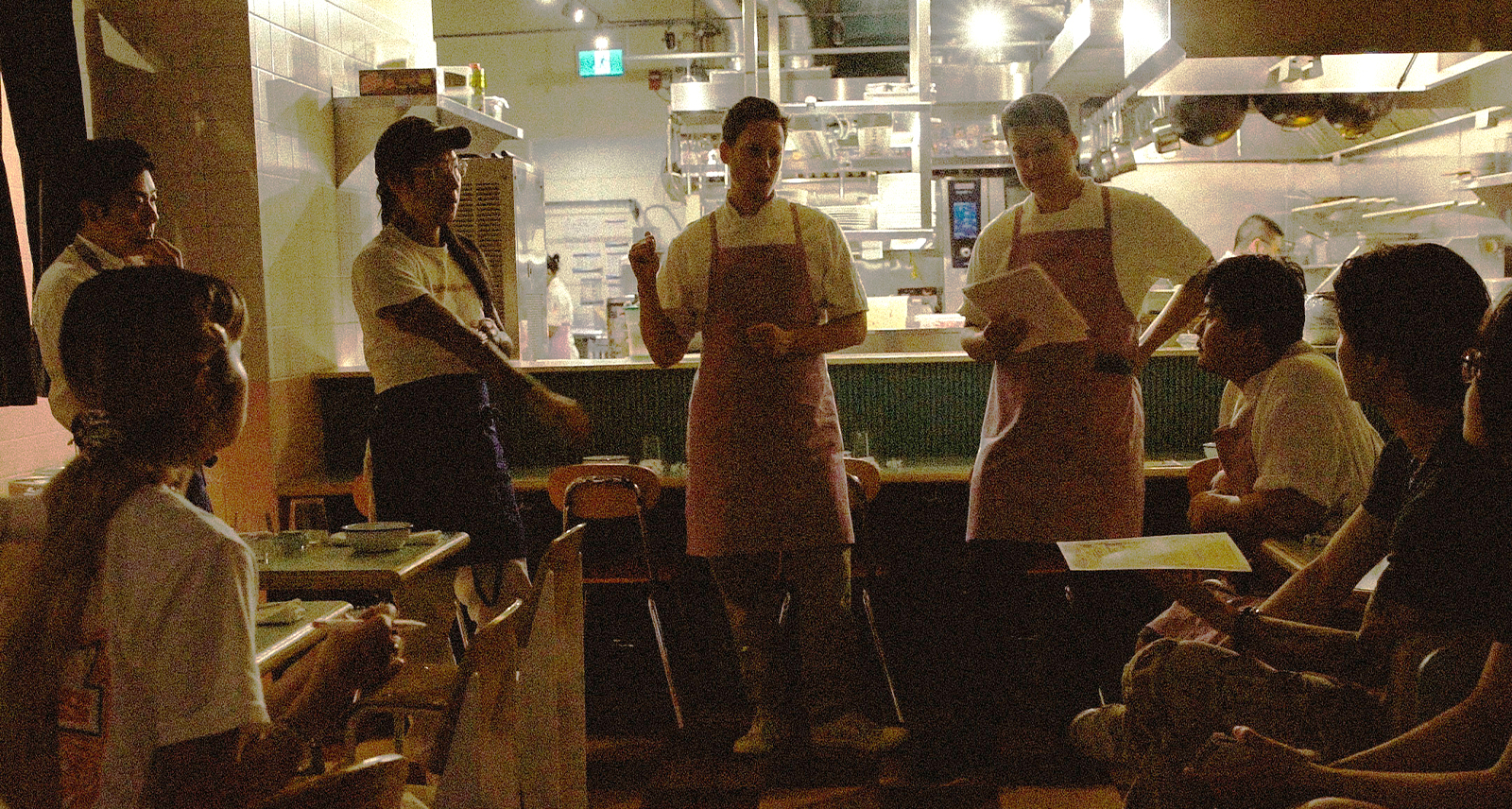
The dining room at Sunny’s Chinese was absolutely buzzing last Wednesday, and for good reason. For one night only, the Toronto hot spot — known for its modern take on Chinese regional cuisine — invited Danny Bowien, the James Beard Award–winning chef behind Mission Chinese, for a collaborative dinner. Bowien’s playful edge blended with Sunny’s stripped-back, ingredient-driven style.
Ahead of service, Bowien joined Sunny’s co-owners, David Schwartz and Braden Chong, for a revealing round-table with SHARP. The trio swapped stories about the dinners that brought them together, the pressures and payoffs of chef collaborations, and why the next wave of Chinese food might be the simplest — and most exciting — yet.


SHARP: So, tell us about the dinner — how did this come about? What do you have planned?
David Schwartz: It’s pretty simple. Between Mimi and Sunny’s, we wanted to set up a circuit of collaborative dinners exploring regional Chinese cooking throughout North America — how different chefs approach the food. We’ve done a few so far. One was with Brandon Jew from Mr. Jiu’s in San Francisco, which I think is one of the best contemporary Chinese restaurants in the world. That was exciting for us to cook with him. And as a bonus, he brought Danny to hang out and help.
“You guys are doing it at Sunny’s on this democratized level: food chefs want to eat. Not too edgy or showy, but true to what Chinese food is.”
Danny Bowien
Danny Bowien: Brandon was doing that dinner, and I’d already heard a lot about these guys. We have a mutual friend, the food writer Kyle Beachy, and they were on my radar because, honestly, everyone’s Instagram feed was full of their biang biang noodles. I thought, “Oh, that’s them.”
Brandon’s one of my best friends — the reason I started cooking Chinese food. So, I told him I wanted to come help out. He said he didn’t need help, but to come anyway. At first, I felt like a third wheel, but he encouraged me.
My first night here we went to Sunny’s for dinner. I was impressed. Brandon and I always talk about what kind of Chinese food we want to eat and cook. You guys are doing it at Sunny’s on this democratized level: food chefs want to eat. Not too edgy or showy, but true to what Chinese food is. For years, we wondered why no one had done with Chinese food what Charles Phan did with Vietnamese at Slanted Door — sensible cooking, great ingredients, good technique. That’s what impressed me.
David Schwartz: It’s funny — outside Toronto, if people have heard of our restaurants, chefs usually know Sunny’s first.
“Early in my career, I loved working in other kitchens, learning how different chefs worked. Now I don’t get to do that, but these collabs give me that chance. You see how another chef thinks, pick up techniques, share ideas.”
Braden Chong
What do you get out of collaborations like this?
Danny Bowien: When I was younger, I used collabs to test untried ideas. Now, I think about it like going to see a band — you want to hear the hits. So when I travel, I bring dishes I know work, instead of trying something new and risky.
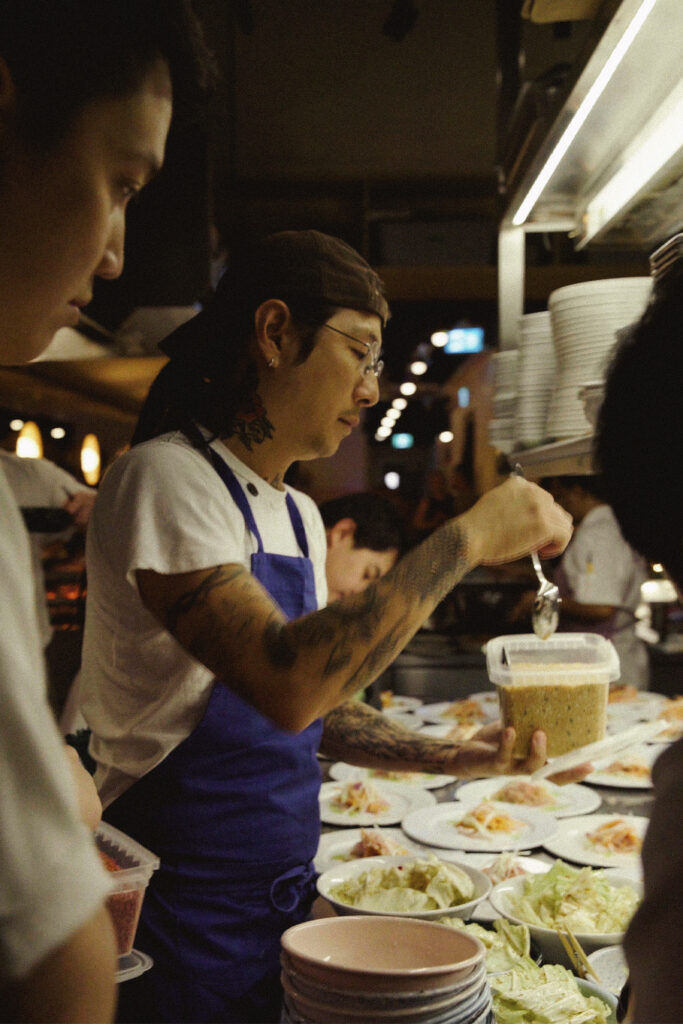
Of course, you still want to impress your peers and exchange ideas, but really, it’s about the energy in the kitchen, the camaraderie. And, honestly, it’s refreshing just to cook again. When you get to a certain level as a chef, most of your job is admin. Events like this put a knife back in your hand. You’re cooking shoulder-to-shoulder, sharing techniques. That’s the fun.
I also don’t drink anymore, so collabs have become less about the after-party and more about the cooking itself. After having a kid, I’m a lot chiller, and I can just enjoy the process. Working with these guys has been great — their “80%” is other chefs’ “100%.”
David Schwartz: For us, it’s the opposite. Our regulars eat with us all the time, so we want to offer something new. But when someone like Danny comes in, we want him to do the hits — dishes Toronto diners don’t usually get access to. With Brandon, with Bo Lee from Vancouver, with anyone — we love seeing how each chef approaches Chinese food differently.

What’s going to be on the menu tomorrow?
Braden Chong: These dinners always feel like opening a restaurant for one night. You think you’ve got it set, then you realize you forgot something.
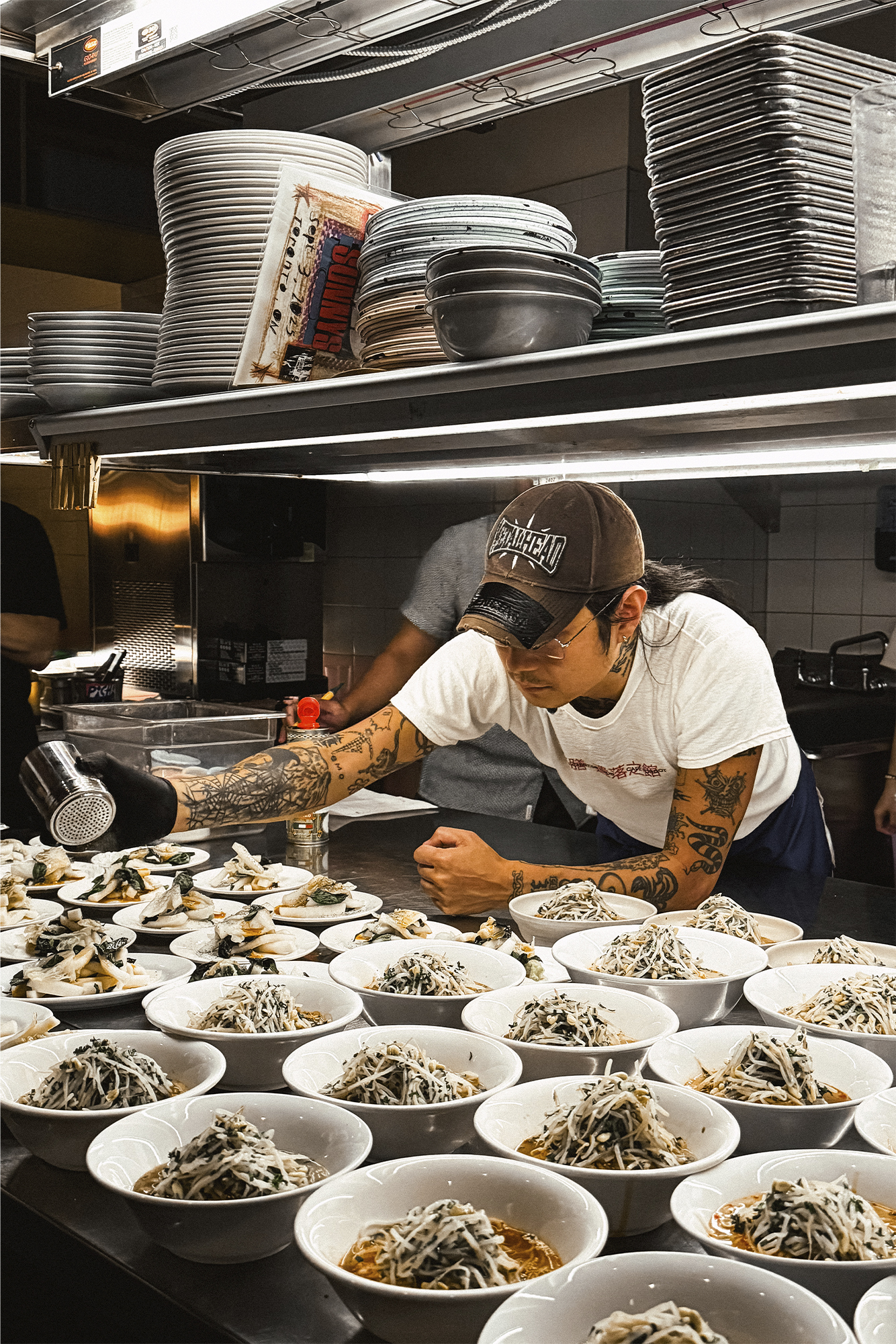
David Schwartz: We’re doing a take on our husband-and-wife beef, with peak-season tomatoes, tendon, master stock, and chili oil. Danny’s doing his addictive cabbage salad. Together we worked on a Yuxiang-style salad with julienned vegetables and amberjack, plus a raspberry-lychee dressing he brought. Then there’s the sprite noodles.
“Regional Chinese food has endless depth and technique. It deserves to be treated with the same seriousness as French or Japanese. Collaborations like this shine a light on it.”
David Schwartz
Danny Bowien: Yeah, sprite noodles came from a hot pot place in San Francisco where they used Sprite in the dipping sauce. Sounds wild, but it works. We developed it at Mission Chinese and people loved it. So I thought — why not bring it here? With Sunny’s chili oil, it’ll be great.
David Schwartz: We’re also doing a charcoal-grilled beef rib with salted olive sauce, Danny’s chicken wings with Sichuan kimchi, as well as his kung pao pastrami with the pastrami coming from Linny’s. We’ll also have hakurei turnips with a mock XO sauce using lion’s mane and black garlic.
Braden Chong: Vegetables are a big part of Chinese food — stir-fried with garlic, dressed with XO. At Mimi and Sunny’s, we like food that looks simple but surprises you with complexity.
Braden, what’s your favourite part about working with guest chefs?
Braden Chong: Honestly, it’s like getting to stage again. Early in my career, I loved working in other kitchens, learning how different chefs worked. Now I don’t get to do that, but these collabs give me that chance. You see how another chef thinks, pick up techniques, share ideas. Selfishly, that’s my favourite part.

Where do you see Chinese food going — the “next wave”?
Danny Bowien: I think it’s moving toward simplicity. We’ve gone from irreverent Mission Chinese-style food to ultra-fancy places like Mott 32. The next step, I think, is what people in China actually eat daily: fresh local ingredients, cooked with skill, but not fussed over. That excites me.
Braden Chong: Danny inspired us even before Mimi and Sunny’s existed. Now it feels like we’re part of the next wave too. Awareness has shifted — ten years ago, “Chinese food” meant Cantonese to most people. Now diners know about Sichuan, Guizhou, the north and south. Social media helped, but it’s also chefs pushing it forward.
David Schwartz: That’s why our restaurants exist. Regional Chinese food has endless depth and technique. It deserves to be treated with the same seriousness as French or Japanese. Collaborations like this shine a light on it.
“Nothing’s more gratifying than cooking for Chinese guests — passing the “legit check.” That’s when you know you’ve done it right.”
Danny Bowien
Danny, early in your career did anything surprise you about how people reacted to your food?
Danny Bowien: Not surprised, but it’s different now. When I started, there was no YouTube. If you wanted to learn, you had to buy cookbooks, beg chefs to talk to you, or stage for free. Recipes often didn’t even work. Now there’s an overload of information — good and bad.
The value of collabs is that they cut through the noise. Cooking with other chefs at the events is sort of like learning guitar — you can look up 20 tabs online, most of them are wrong. Or you can sit with the musician who wrote the song and ask how to play the bridge. [Speaking directly] to a chef who has years of trial and error is the best way forward.
David Schwartz: For me, it’s the question of value. Korean food in the U.S. now commands $150 tasting menus, and people accept it. Here, that mindset is still a challenge. It’s why we talk about provenance so much — showing guests the ingredients, the farmers, the labour behind the food. Otherwise, people say, “Why wouldn’t I just go to Chinatown?”
“We want to showcase the depth of regional Chinese food, highlight provenance, and push the conversation forward. That’s the mission.”
David Schwartz
Where do you see Toronto in the bigger picture in terms of Chinese cuisine?
David Schwartz: Honestly, Toronto’s top three cities outside of China for regional Chinese food. That’s why our restaurant exists. On our website we list thirty other restaurants in the city that inspire us.
Danny Bowien: Yeah, and nothing’s more gratifying than cooking for Chinese guests — passing the “legit check.” That’s when you know you’ve done it right.
David Schwartz: When we started Sunny’s, even our Chinese suppliers laughed at the idea of us cooking this food. Now they book their Christmas dinner at Mimi. That’s the best validation.
Braden Chong: Totally. At first they’d ignore our emails or texts. Now they’ll source ingredients for us, even a year later, just because we asked. The relationship has completely changed.
What do you want to see for the future of Chinese food here?
Danny Bowien: Mission Chinese started because I couldn’t cook Cantonese properly, so I cooked Sichuan — it was the opposite of what the Cantonese staff were eating. Over time I learned the nuances, but it taught me that multi-regional menus will always hit a nerve: too salty for Cantonese, not spicy enough for Sichuanese. You’ll never please everyone, so you just focus on consistency.
David Schwartz: Exactly. Our food will never make everyone happy, but we want to showcase the depth of regional Chinese food, highlight provenance, and push the conversation forward. That’s the mission.