If you’ve been plugged into internet culture over the past few months, you’ve likely come across the term looksmaxxing. While buzzwords like this seem to pop up overnight, this one in particular is sticking around longer than anticipated — and it has quite a dark backstory.
‘Maxxing’ became a popular suffix across online incel communities during the 2010s. (‘Incel,’ in turn, is slang for involuntarily celibate.) In this space, ‘looksmaxxing,’ referred to maximizing one’s physical attractiveness to heighten their ‘sexual market value.’ From here, other ‘-maxxing’ words — also tied to self-optimization — were coined: ‘gymmaxxing,’ ‘moneymaxxing,’ ‘heightmaxxing.’ all of which were birthed through a shared resentment over sexual rejection. Today, the suffix has become sprinkled across many Gen-Z conversations (sleep-maxxing is the one I can get behind) that its incel origins are often forgotten, flattened into something that sounds playful rather than insidiously loaded.
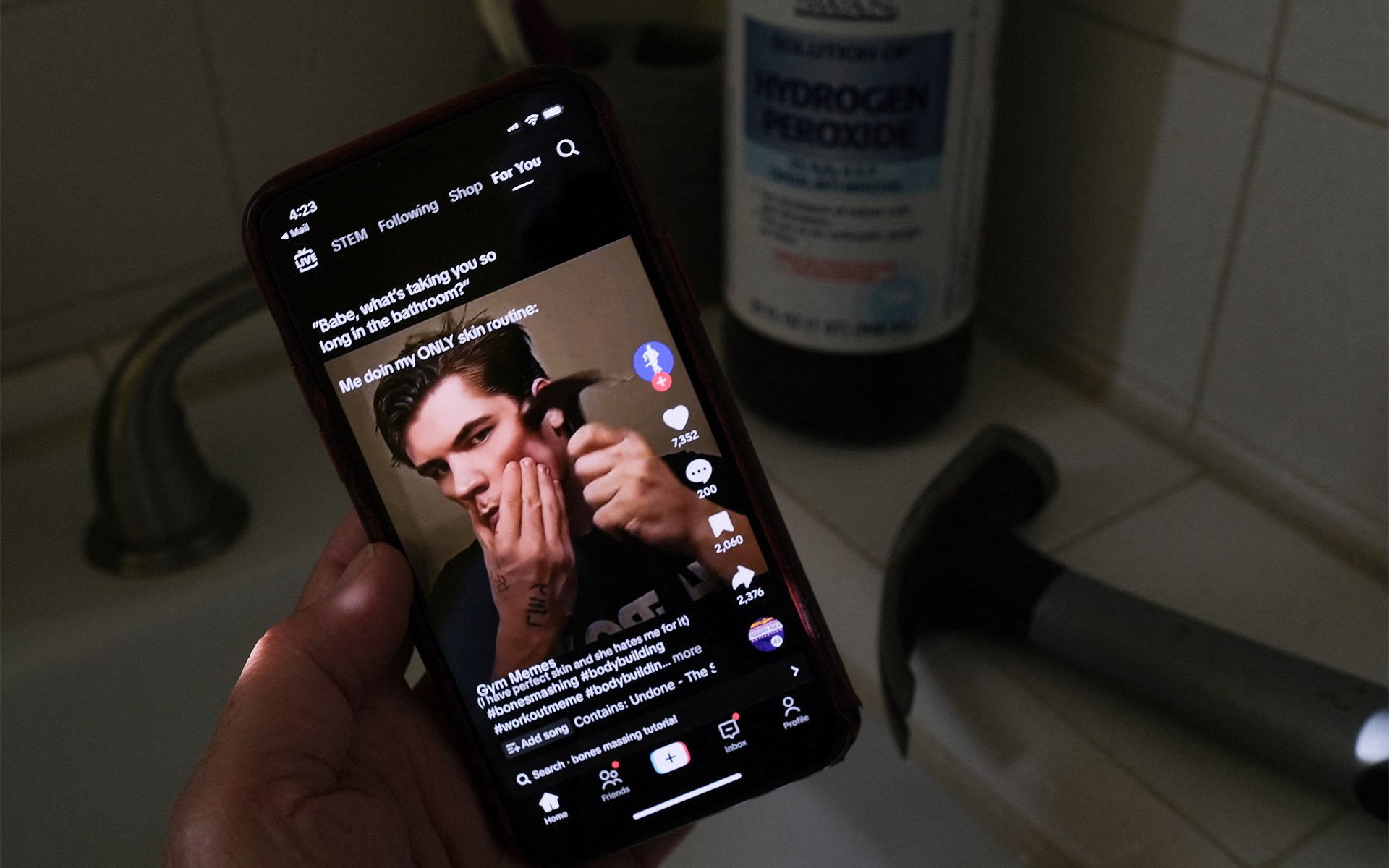
In the same vein, other terms have emerged from incel communities, such as ‘mewing’, an unproven method of sharpening the jawline by resting the tongue against the roof of the mouth, keeping teeth closed, and breathing through the nose, or ‘mogging’, a form of domination based on looking significantly better than someone else. These, along with ‘looksmaxxing’, demonstrate how the beauty vernacular behind young men’s pursuit of beauty has haphazardly evolved, blending pseudoscience and algorithm-driven aesthetics into an echo chamber of digital masculinity.
The mascot behind this world is Clavicular, a 20-year-old influencer and streamer pushing the looksmaxing narrative into the mainstream. At the core of his practice is promoting concerning perfection habits (such as exploring limb-lengthening surgery and breaking bones to improve jawlines). He has also openly admitted to taking a cocktail of drugs like testosterone, Accutane, and crystal meth to amp up his appearance.
He’s called himself the ‘lab rat of the community,’ meaning he will try anything to see what works, sticks, and provides results. But even that kind of trial-and-error needs an example to follow. In the quest for this unattainable goal, he has a reference point: actor Matt Bomer, whom he considers the most harmonious and idealistic—apparently based on harmony ratios. In this sphere of evaluating one’s appearance, some celebrities are seen as the pinnacle of beauty and serve as a reference for successful attractiveness.
There’s also an area of this manosphere universe where people submit their personal selfies for evaluation, and commentators rate each other on a scale of 1-10 for attractiveness. In this community, appearance is linked to reproductive value, suggesting that a lower score indicates less desirable genes to pass on. It’s about this pursuit of perfection, by any means necessary, while also vulnerably putting yourself on the line to be scrutinized.
This entire movement clearly exploits insecurity. While masquerading as ‘self-improvement’, it lures many young, impressionable people into this space, reducing self-worth and value to a single outcome—top appearance—while reinforcing the idea that anything less is a failure, which can quickly distort how a generation moves through the world. This movement raises an unsettling question: What will happen to a generation that views itself as projects to be optimized and fixed? Especially when they realize that the project never stops.
Feature photo by Chris DELMAS / AFP) (Photo by CHRIS DELMAS/AFP via Getty Images