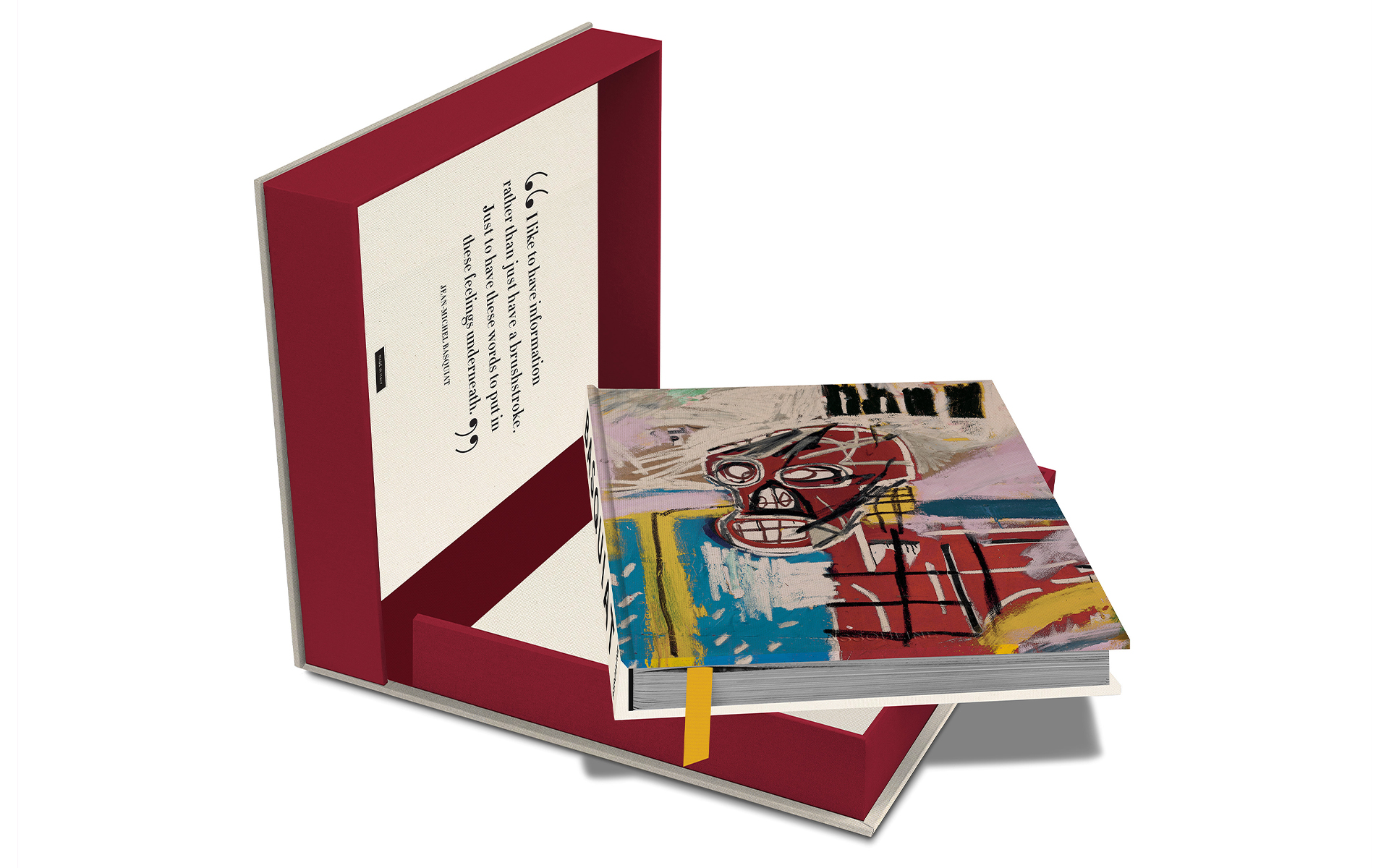
Few artists have managed to leave a cultural footprint as expansive as Jean-Michel Basquiat. Decades after his death, the Brooklyn-born painter remains a touchstone not only in contemporary art, but across fashion, music, design, and popular culture. A new Assouline release, “Basquiat: The World of Jean-Michel”, sets out to examine exactly why his influence still feels so immediate.
Published as part of the luxury publisher’s Ultimate Collection, the oversized volume reframes Basquiat not simply as a painter, but as the centre of an entire creative ecosystem. Instead of following a straightforward biographical timeline, the book approaches his career through broader ideas and recurring motifs — identity, race, mythology, masculinity, urban life, and artistic experimentation among them.
The result is something closer to a cultural study than a conventional coffee-table retrospective.
Spanning more than 200 images, the book combines landmark paintings with archival material and commentary from artists, collectors, musicians, and collaborators who either knew Basquiat personally or continue to draw inspiration from his work today. Contributors include George Condo, Peter Brant, and Lenny Kravitz, alongside reflections from late cultural figures such as Keith Haring, bell hooks, and Valentino Garavani.
Among the featured works are some of Basquiat’s most recognizable and emotionally charged paintings, including “Red Skull” (1982), as well as lesser-discussed silkscreen works from the mid-1980s and the unsettling “Untitled (Devil’s Head)” from 1987. Throughout, the book emphasizes the restless energy that defined his practice — canvases layered with text fragments, anatomical sketches, symbols, and references that moved fluidly between art history, jazz, African diasporic culture, and street life.
New York itself emerges as a major character in the publication. The noise, tension, and creative collisions of the city’s downtown scene are treated as essential ingredients in Basquiat’s visual language, shaping both the urgency and unpredictability of his work.
“This is a project that goes beyond an overview or a specific aspect of Basquiat’s multifaceted art,” says Bruno Bischofberger, the influential dealer who represented Basquiat internationally beginning in 1982.
The book was developed in collaboration with Colour Themes, the advisory firm founded by Philip Rebeiz and CJ Jones. Known for its research-heavy approach to modern and contemporary art, the group brings a scholarly lens to the publication, pairing visual material with fresh analysis and contextual essays. Even the object itself has been designed with collectors in mind. Encased in a textured clamshell inspired by the feel of an artist’s canvas, the edition leans into the tactile sensibility that defined Basquiat’s own approach to materials and mark-making.
More than 35 years after his death, Basquiat’s work still carries a rare kind of electricity — raw, confrontational, and impossible to neatly categorize. “Basquiat: The World of Jean-Michel” doesn’t attempt to tidy up that complexity. Instead, it embraces the contradictions and intensity that made him one of the most important artists of the late twentieth century — and one whose influence shows no sign of fading.