There are some days in life that stay with you. For me, this was one of those days. Actually, it was two days. Two days of driving in circles around the most revered, most dangerous, most awesome racetrack on Earth.
For nearly 100 years, the Nürburgring Nordschleife — hidden in the dense forests and hills of Germany’s Eifel region near the country’s western border — has drawn drivers in like moths to a flame. Originally, the circuit was a testing ground for Germany’s nascent auto industry, then it was a Formula 1 Grand Prix venue, and then, after it was deemed too dangerous for F1, the Nordschleife became a sort of playground for gearheads and speed demons.
It’s our Mecca: anybody can come to Germany and drive the Nordschleife. It’s technically just a toll road, albeit a rather deadly one. Nobody keeps tabs on the death toll, but fatal crashes do occur at the Touristenfahrten (tourist days), when the track is open to the public, as well as during professional races. The track has claimed all kinds of drivers — good ones and bad.
Despite all this, the Nordschleife is more popular than ever. Last year, none other than Max Verstappen, the freakishly fast four-time Formula 1 champion, climbed down from the ivory tower of F1 to slum it in a GT3 racecar at the Nordschleife because, well, he just wanted to drive the ‘Ring. This year, Verstappen went back to race the Nürburgring 24 Hours.
Like Verstappen — and this is the only way we’re alike — I too just wanted to drive the ‘Ring. After countless virtual laps in Gran Turismo as a kid, after watching all the lap records on YouTube, and hearing about the lore of this place, I wanted to see what it was like IRL.
Luckily, BMW M runs a pretty spectacular driving school at the Nordschleife. It was called the “BMW M Experience: Nordschleife” but rebranded as “Area M: Nordschleife” — the point is, it’s open to anyone who has €4,590 (roughly $7,200) to burn on two days of driving. Classes run several times per year. Each one has around 70 participants, and it routinely sells out.
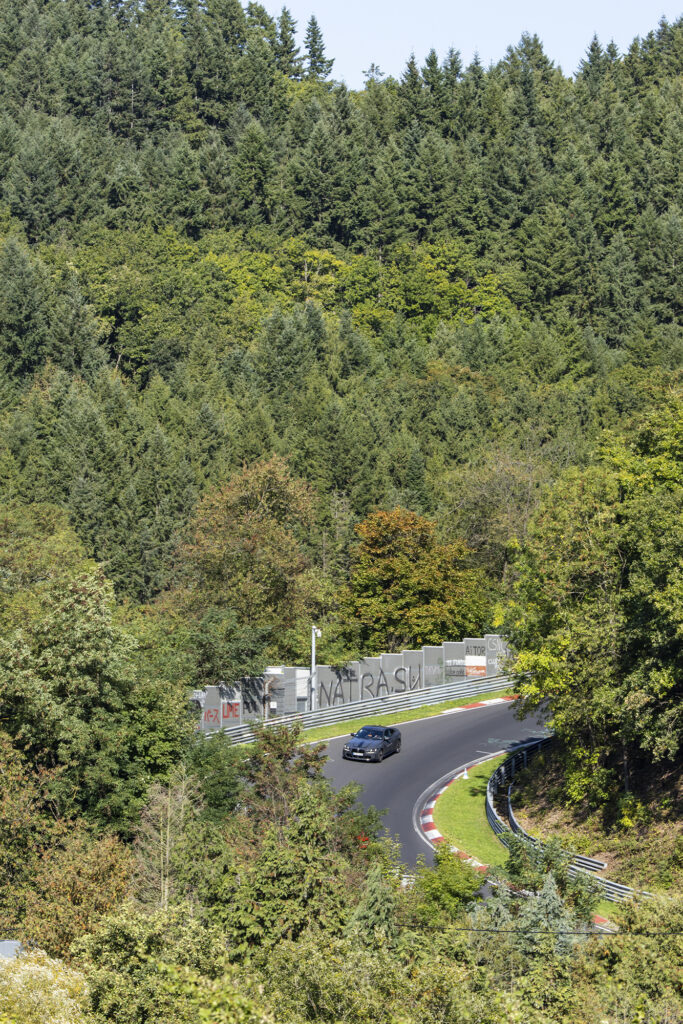
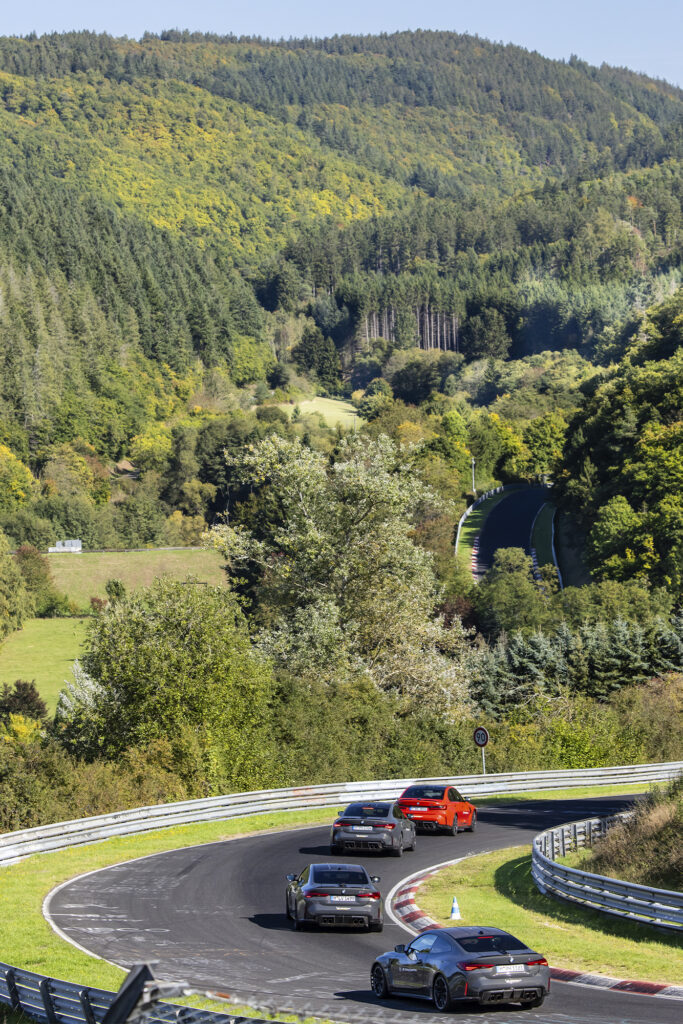
Meals and a room at the trackside hotel are included, as is professional guidance from one of BMW’s elite driving instructors. Crucially, BMW’s M division provides the cars.
On the drive from Frankfurt airport, it all starts to feel real. I’m nervous. A highly decorated racer I know cautioned me to treat the track with respect. “Just be really careful. Start slow,” Jörg Bergmeister warned me over the phone. “It’s just the ultimate track. There’s nothing like it. It’s the ultimate challenge for a driver,” he said. “It’s always a gamble, how much risk you’re willing to take, and obviously a question of talent as well, how close can you go to the limit and get away with it.”
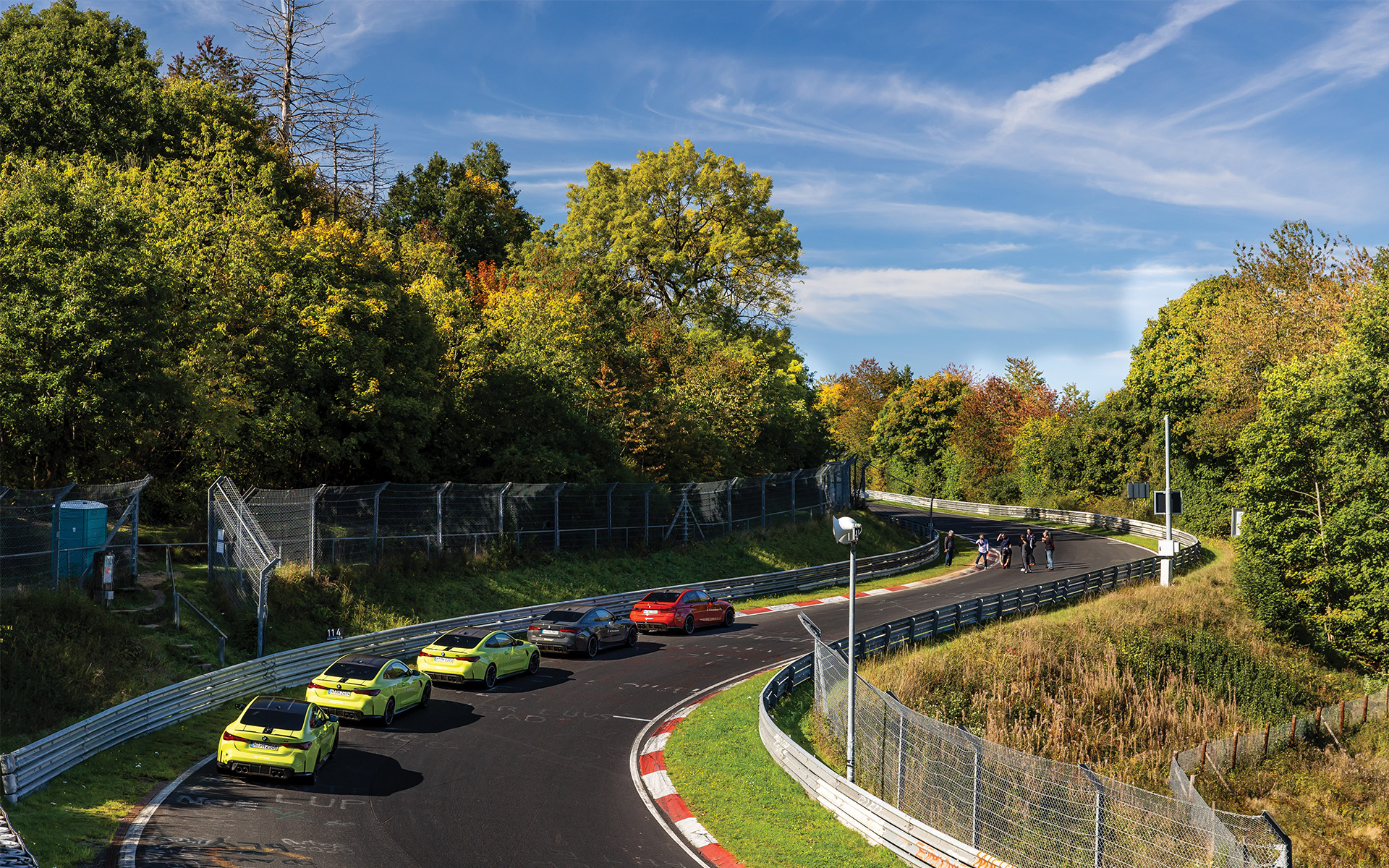
Outside my hotel room window is a parking lot full of candy-coloured BMW M4 Competition coupes, the rear-wheel-drive model with an eight-speed automatic gearbox. They’ve got 523 horsepower, 479 lb-ft of torque, and a fresh set of Michelin tires.
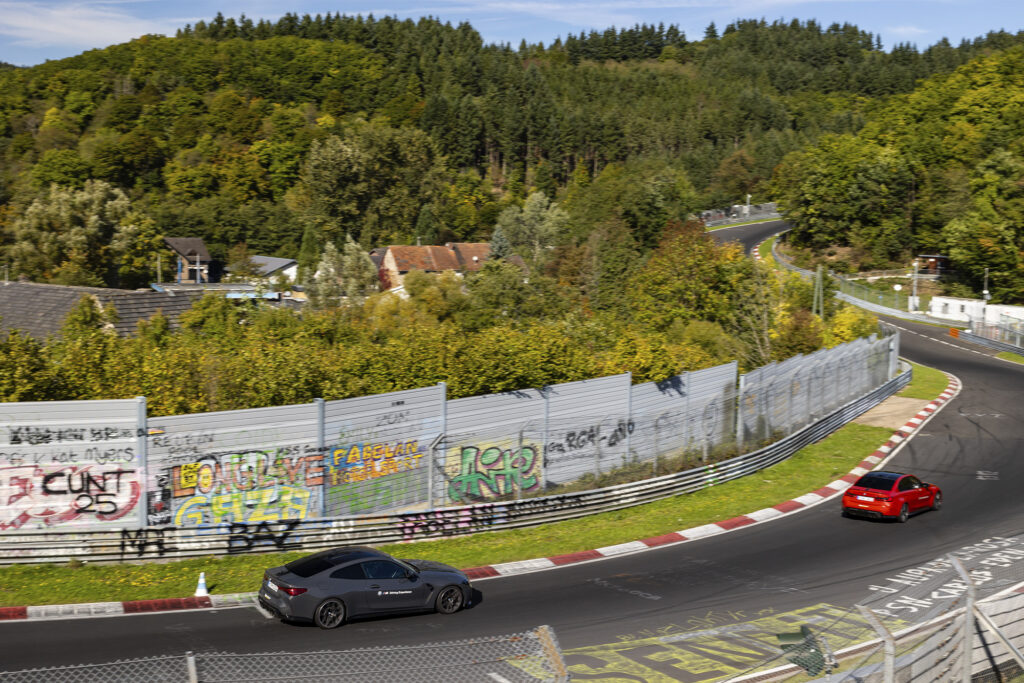
A few of these pristine M4s will be smashed into the Nordschleife’s metal barriers before our two days here are done.
The morning we hit the track, the weather is crisp but mercifully sunny.
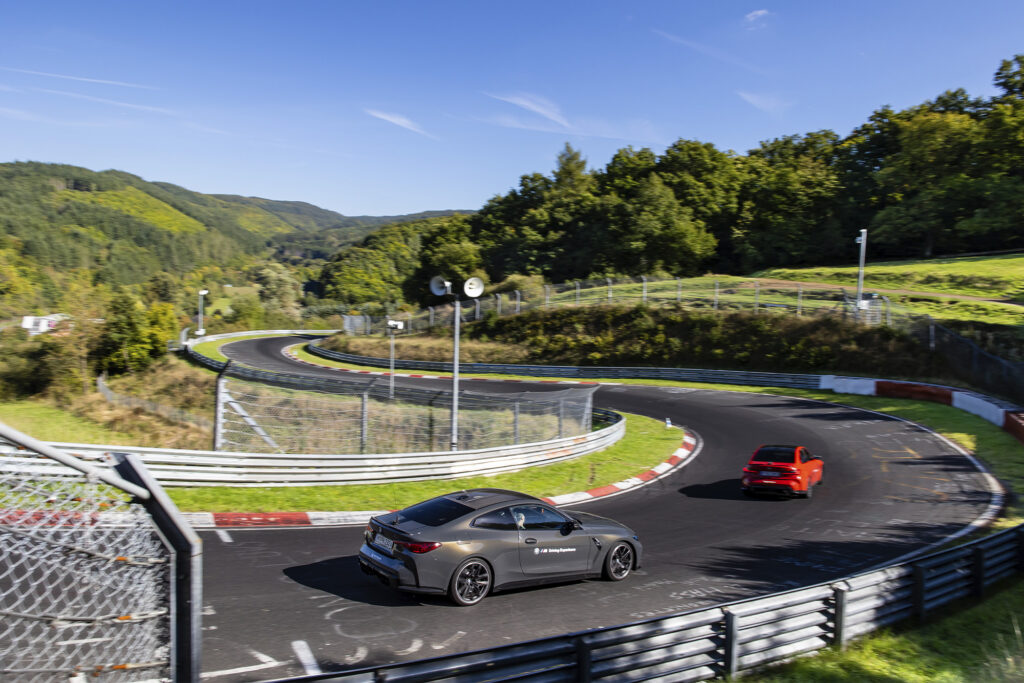
“Welcome to the Nordschleife,” says Ricardo Sanchez over the radio as he leads our group of eight drivers out onto the circuit. He’s driving an M3 sedan in front while our group follows along in M4s, a bit like ducklings swimming after their mother. Without Sanchez, we’d be lost — or possibly dead.
After passing through the gate onto the track, the first thing you see is an ambulance, parked like one final warning: be careful.
Sanchez, a professional racer, gives us a live play-by-play of exactly how to tackle each corner.
“After the crest, touch the brake, off the brake, back to the power to put some weight on the back, and now we brake hard, brake hard, behind me, behind me, go in, go in, go in,” he says through the terrifyingly fast left at Schwedenkreuz and the long right at Aremburg. (All the corners have impossible German names.)
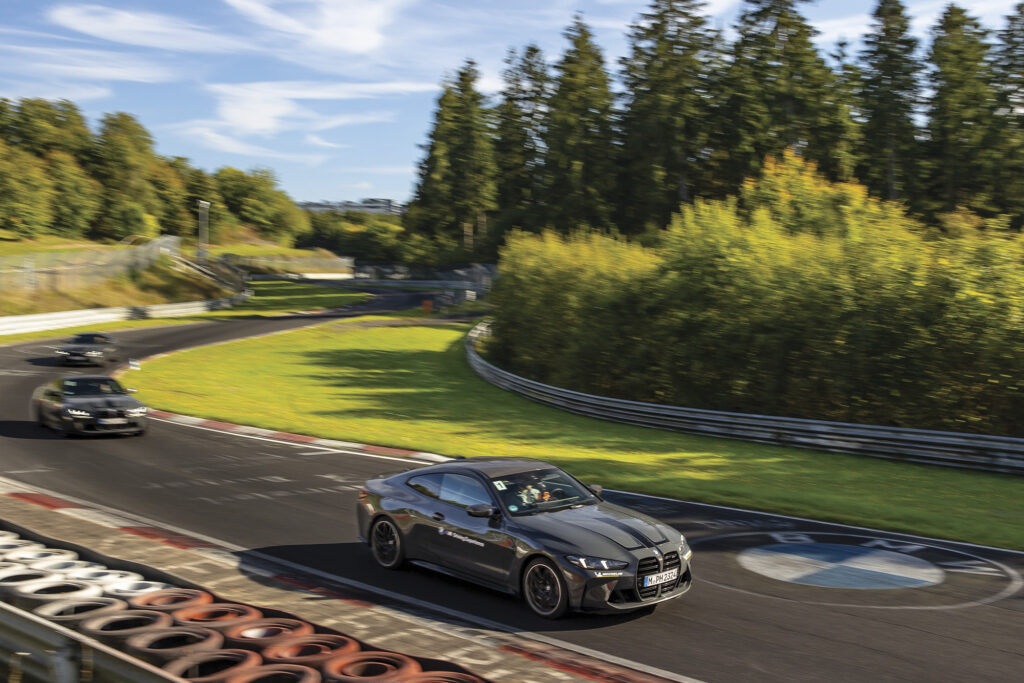
Sun dazzles through the trees that line the circuit, slowly burning off the morning fog that blankets parts of the track. It’s shockingly beautiful, bracing, almost dream-like as we slice through the fog on this first lap.
Sanchez continues narrating: “Then Niki Lauda corner, which is named after him, where his famous accident happened.”
Lauda’s fiery and near-fatal crash at this corner during the 1976 German Grand Prix is what finally put an end to F1 racing at the Nordschleife; it was simply too dangerous.
“High speed, to the left, no braking,” Sanchez calls out. “And then Bergwerk, tricky corner, braking in the middle towards the outside and then we start going down, looking for grip, compression, back on the power and open the wheel.”
As the two days progress, we pick up speed. Because BMW rents the entire Nordschleife, we can learn the track in pieces. We drive a half-dozen corners, turn around, and run them all again and again. It’s the only way. Your brain simply can’t memorize all 73 corners of this 20-kilometre circuit in one shot. It is to other racetracks what the Pacific Ocean is to a pond.
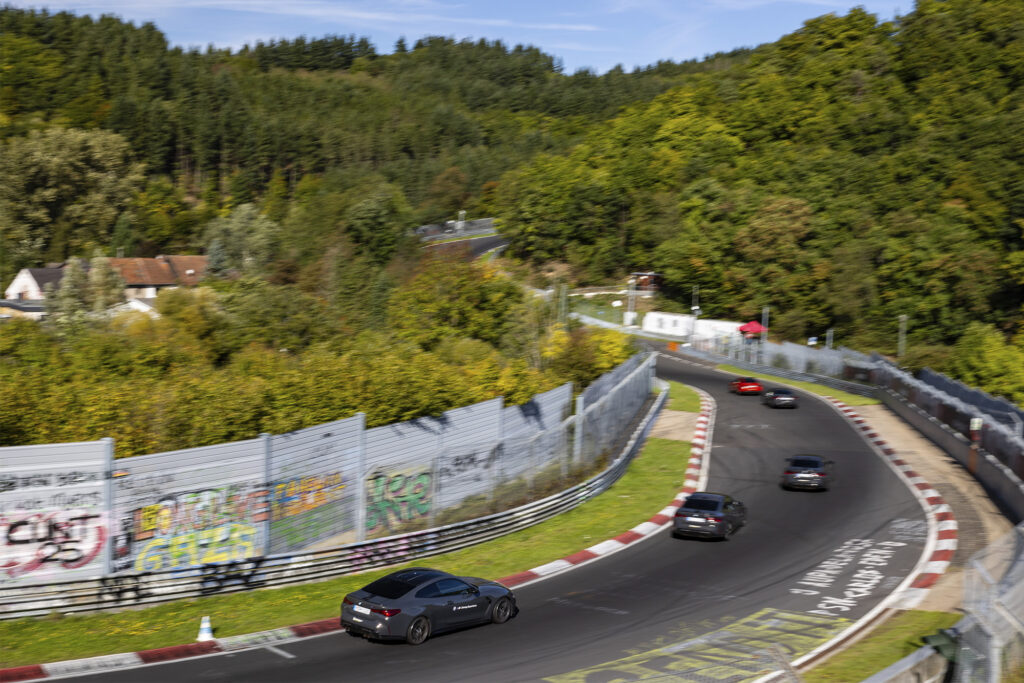
By day two, we’re flying through the fast left at Schwedenkreuz and onto the long right of Aremburg, hitting over 220 km/h. The M4 bounces and weaves over the bumpy surface, but remains utterly planted. This car can be a tail-happy hooligan if you want it to be, but here, with all electronic safety systems switched on, it’s a precise and totally predictable partner.
Going fast uphill, you can arrive at Mutkurve doing over 200 km/h, and the only runoff is a patch of wet grass. After that, it’s a cold metal guardrail. Ignore that. Look to the inside, don’t let the wheels touch the curb, and pray you haven’t overcooked it.
Karussell, the track’s famous banked turn, is like being on a violent merry-go-round and jumping off mid-ride. The car literally jumps out of the banking.
Approaching Pflanzgarten 2, Sanchez warns: “Very tricky corner. If you don’t land properly you go straight into the inside wall at 200 km/h. We had an accident there yesterday.”
By the end of day two, several other drivers in our group of 70 have crashed. Only egos were injured. Apart from that, these showroom-fresh BMW M cars didn’t break a sweat.
So what’s the enduring appeal of the Nordschleife? Why does it keep pulling in drivers? For one thing, it’s beautiful. It’s more like the ultimate mountain road than a racetrack, an endless string of corners, each one flowing into the next. For another thing, it’s dangerous. While other tracks are sanitized with wide gravel traps and runoff areas, the ‘Ring remains more or less as it was 100 years ago. The narrowness heightens the sense of speed.
As the sun gets low above the trees, we’re out running our last full fast laps. Our group catches another string of M4s and chases them through several corners before passing in a blast of engine noise. It’s glorious. Driving at the Nordschleife is driving in its purest, freest, most adrenaline-addled form. It’s the platonic ideal, exactly how you’d imagine it as a kid playing a video game. And that’s why I’m already itching to get back there.