Life hasn’t always been easy for the 111-year-old Italian automaker Maserati, but if its tumultuous history has taught us anything, it’s that Maserati is never out of the race. The company has survived at least five major financial crises and seven changes of ownership. And yet, despite that, Maserati’s Trident still means something. It still evokes a particular Italian tradition of art, style, and technical innovation, and it still stands proud on the nose of some of the most desirable cars in the world.
“With MCPURA, Maserati is once again regaining its rightful place: at the top and in its stomping ground.”
Santo Ficili, head of Maserati.
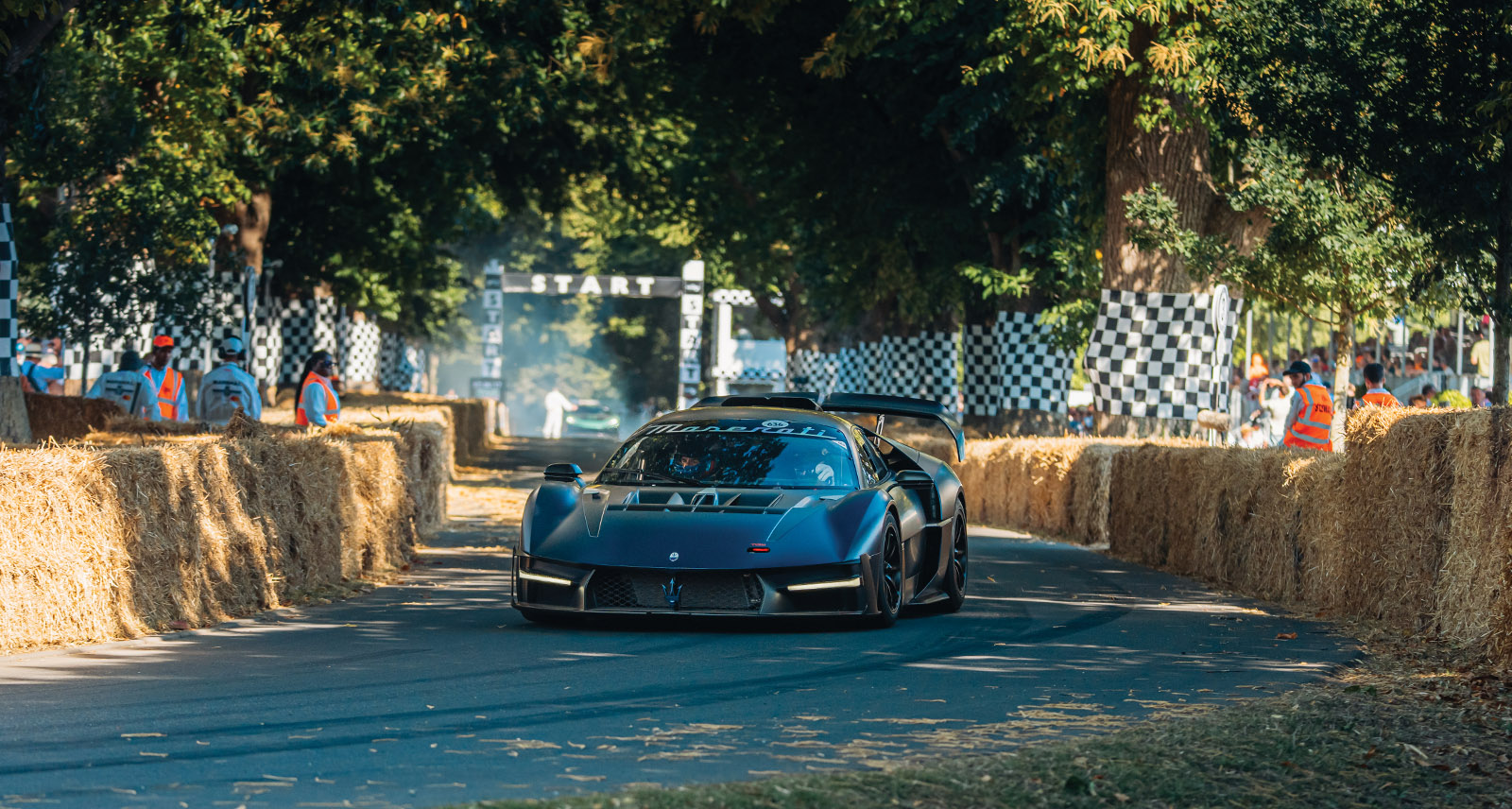
We were reminded of that fact recently on the lush green lawns of the Goodwood Festival of Speed, where Maserati was out in force. The brand showed off the new titanium exhaust system on its fierce GT2 Stradale — a road-going race car — by sending it up the hill climb at full tilt. The crowd was stunned into silence by the sheer volume of the car’s raw mechanical howl. Development of the new exhaust was handled by Maserati Corse in collaboration with Italian specialists Tubi Style. It’s hand-welded to the highest standard, looking almost like a work of art, which, of course, is what we expect from Maserati. And that was merely an amuse-bouche for Maserati’s onslaught of new machinery at Goodwood.
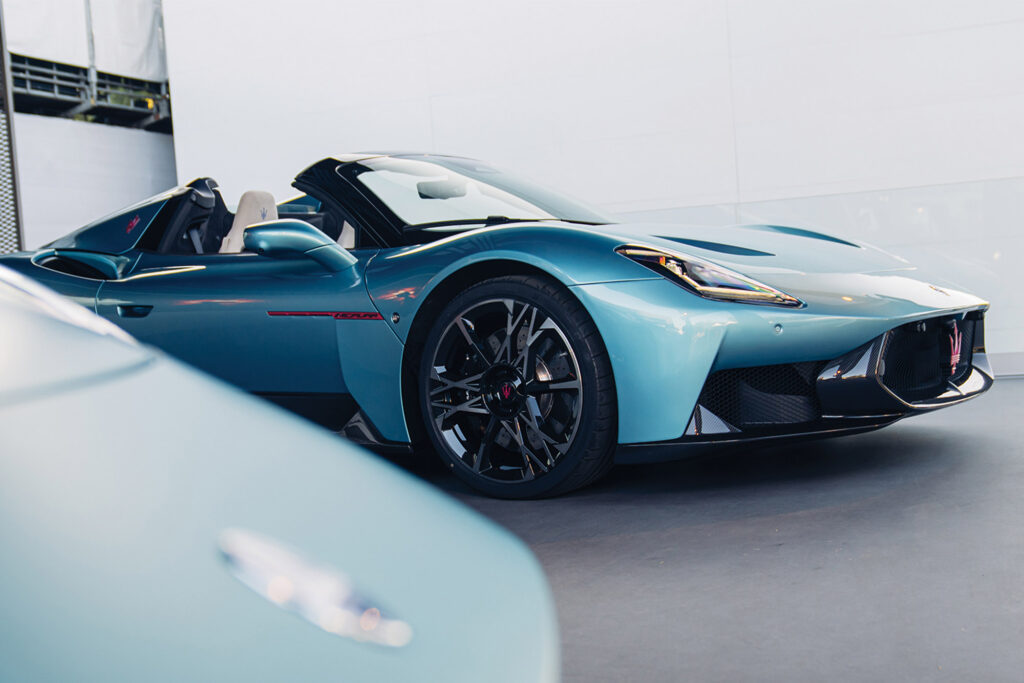
The Italian firm’s track-only MCXtrema, one of only 62 examples, made its garden-party debut. It shares its 730-horsepower V6 Nettuno engine with the gorgeous new Maserati GranCabrio, albeit detuned in the Cabrio to 483 hp, a much more appropriate figure for a globe-trotting grand tourer. Both cars went up the hill in their own unique fashion, but it was Maserati’s latest flagship supercars — the MCPURA coupe and the delectable MCPURA Cielo droptop — that grabbed headlines.
“With MCPURA, Maserati is once again regaining its rightful place: at the top and in its stomping ground,” says Santo Ficili, the head of Maserati. “Both versions — coupe and Cielo — are created at our historic Modena facility, where the heart of the Trident has been beating for nearly 90 years. This is where the entire MCPURA production process takes place: we produce the Nettuno engine, assemble each component, and carry out the most exclusive customization at the Maserati Officine Fuoriserie.” Ficili continues, saying, “Modena is not just our headquarters; it forms part of our identity. We are the oldest automotive marque in the Motor Valley, an area we helped to build and continue to represent around the world. From there, we proudly tell the story of Italian excellence and luxury.”
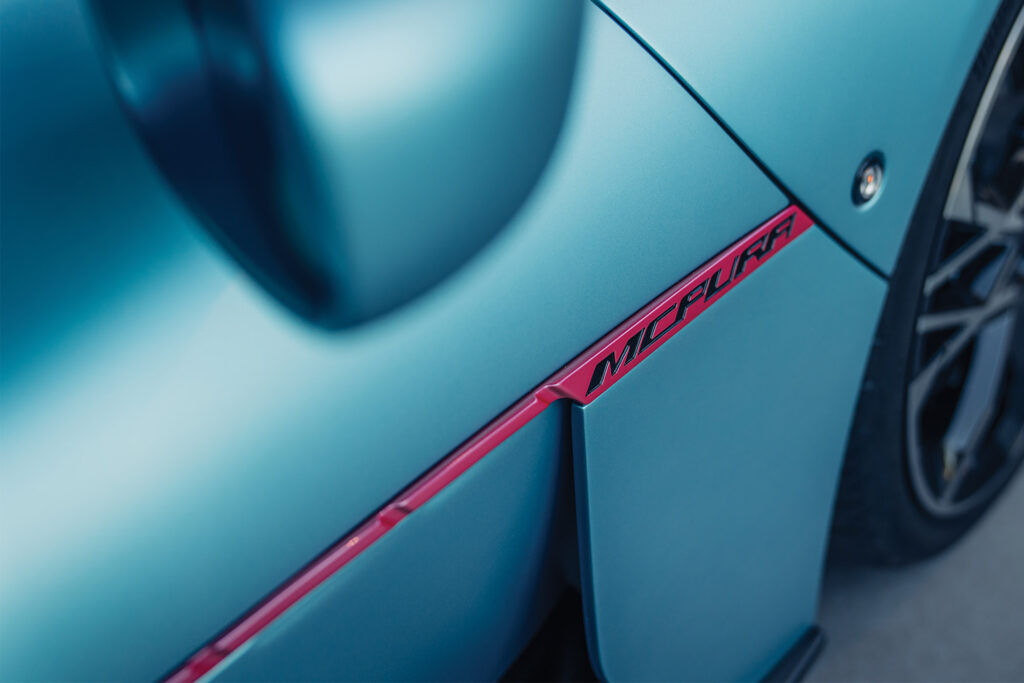
That’s right — Maserati is the oldest carmaker in Italy’s famed Motor Valley. It predates Ferrari and Lamborghini, not to mention any of those young upstarts like Pagani. As for the new machinery, well, only a keen observer will be able to pinpoint the differences between the new MCPURA and Maserati’s previous flagship, the MC20. As Maserati explains, “work has focused on the exterior design, materials, and interior finishes, but the core remains the same: the powerful and unmistakable 621 hp V6 Nettuno engine.” As is evident throughout Maserati’s long history, the brand always pushes forward, no matter the headwinds.
Since it was founded in 1914 in Bologna (not far from its current Modenese headquarters) by the Maserati brothers — there were six of them, all of whom played at least some role in the company — the firm has seen more than its fair share of ups and downs.
Maserati’s early triumphs in the 1930s, ’40s, and ’50s included four consecutive Targa Florio victories, historic back-to-back Indianapolis 500 wins, and — most famous of all — two spectacular Formula One Championships with Juan Manuel Fangio at the wheel of the groundbreaking Maserati 250F. Fangio’s comeback drive to win the 1957 German Grand Prix — in which he overcame a 51-second deficit with only a handful of laps to go — is one of the greatest performances not just in motorsport, but in the whole history of sport.
Later that same year, however, Maserati was forced to pull out of F1 because the brand was in dire financial straits. It went from championship to near bankruptcy in a matter of months. That cycle of boom and bust at Maserati kept repeating throughout the last century and into this one. In recent years, the brand has struggled to get the attention and resources it deserves under the Stellantis umbrella, and its future as part of that Italo-French-American conglomerate is uncertain.
As drivers and appreciators of great design, however, what we care about is not profit margins and sales reports, but the cars themselves. And despite such historical tumult, Maserati still managed to produce marvels of technical grace and form such as the Giugiaro-designed 1963 Quattroporte and 1967 Ghibli, the groundbreaking 1959 Birdcage, the underappreciated mid-engined 1971 Bora, and the Gandini-designed 1974 Khamsin. Even more recent machines, such as the 2003 Quattroporte and 2004 MC12, are already modern classics. And the barrage of new models, starting with the Grecale SUV and topped off by the flagship MCPURA supercar seen at Goodwood, shows Maserati is still its innovative, artistic, passionate self.
Nothing great ever came easy. And we can’t help but think that it is precisely because of all the ups and downs — the money trouble and hot-potato ownership history — that Maserati has been forced into greatness, to make great cars and win great races. Whatever the brand’s future holds, drivers would be wise to pay attention.
PHOTOS COURTESY OF MASERATI.