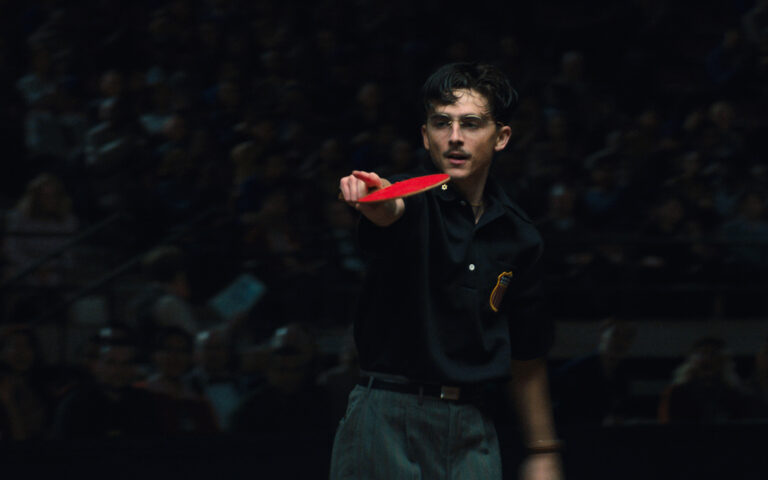
The world has fallen in love with Leo Woodall. And frankly, it’s no mystery why. Up until this fall, the 29-year-old West-London actor had supercharged his career on the back of an uncanny ability to embody a very specific brand of love interest: the endearing, red-flag-laden romantic you can’t help but fall for. If colourful television stints in The White Lotus and Vampire Academy lit the match, his breakout role as the lead in One Day (the 2024 Netflix adaptation of David Nicholls’s novel of the same name) ignited a firestorm of fandom. He followed that up with yet another romcom classic as Renée Zellweger’s young love interest in Bridget Jones: Mad About the Boy, the fourth and final instalment of the franchise based on Helen Fielding’s novels. So, for hundreds of thousands (upon thousands) who had pegged Woodall as the perpetually flawed (but tantalizingly fixable) boy next door, news of his latest project, Nuremberg, offered an entirely new perspective for both the actor and his fans.

If the film seems like a sharp left turn for Woodall, that’s because it was. Admittedly, he isn’t much of a history buff. “I certainly wasn’t one before the film, and I’d be lying if I said I was now. But this is one of the real privileges of what we do. We get to investigate really important areas of life and history that we wouldn’t normally, by instinct, dive into,” he explains. “You know, I never paid attention in history classes in school. Well, I didn’t really pay attention to most classes in school,” he laughs. “But this was a really enlightening film for me, and I think it is for most people.”

What Woodall may have missed in the history classrooms of England’s esteemed Shene School, he made up for in the preparation required to recount one of the most vital moments in modern history. In James Vanderbilt’s Nuremberg, Woodall plays Sgt. Howie Triest, an American soldier sent to monitor Nazi soldiers ahead of the Nuremberg trials. While most of the world is well aware of the atrocities that took place during the war, the film (and Woodall’s character, in particular) underscores the importance of the international trials that followed, which put Nazi military leaders on the record to admit to their crimes against humanity.
Alongside him in this mission is Rami Malek, who shares most of his scenes with Woodall as the chief psychiatrist, Douglas Kelley. Kelley is sent to determine whether the Nazi leaders are fit to stand trial, where he enters a battle of wits against Adolf Hitler’s right-hand man, Hermann Göring, played masterfully by Russell Crowe. Together, Malek and Crowe delivered a master class of sorts to Woodall. At times, the tension between the two left the young actor nearly speechless, with Crowe delivering one of the most captivating, villainous, and charismatic performances of his career.
“If I’m able to do the story justice and help complement the talent in the room, that feels massively successful.”
Leo Woodall
“Between every take, Rami would be so concentrated on trying to think of an idea for the next take. It was always, ‘What little tweaks can we make to elevate this?’ I found it so impressive,” Woodall explains. “I’ve definitely tried to take that on a little bit more myself. And seeing the dynamic between him and Russell, it was just like an acting master class.” He references a specific scene: a Rorschach test administered by Malek’s character to each of the Nazi soldiers, including Crowe, with Woodall’s character translating their responses.

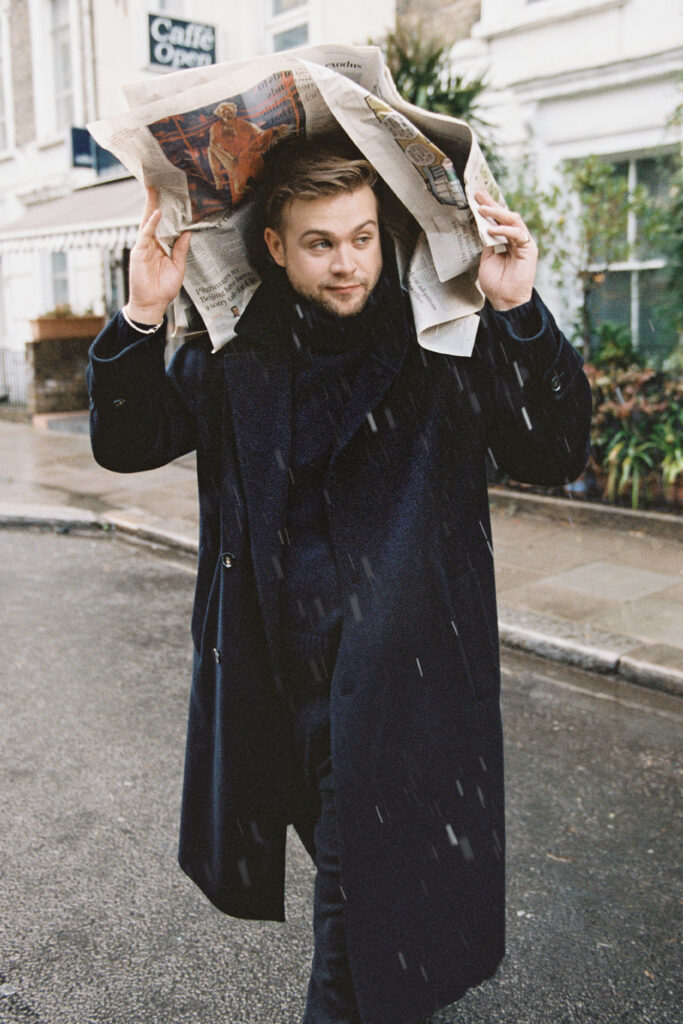
“I’m sitting on the bed between them, and we were doing these long takes because they just kept going, the two of them, trying different things, experimenting with the tension,” he says, laughing at the absurdity of being able to see their work up close. “And, you know, I watched how these two acting juggernauts [were] fighting against each other in real time. It’s kind of like psychiatric warfare. It was just so fucking mesmerizing that when Rami turned to me and asked my character a question, I responded in my English accent because I’d been so enchanted by what they’re doing. I learned a lot, but also, I suppose it was a good lesson to stay in character.”
Sandwiched between a pair of actors who each hold an Academy Award for Best Actor, Woodall not only holds his own but also elevates each moment. Although at the suggestion that he might have even stolen a few scenes from Malek and Crowe, he quickly scoffs. “No,” he laughs, “No, no, no. I certainly wouldn’t say that. […] But if I’m able to do the story justice and help complement the talent in the room, that feels massively successful.”

It’s not as if Woodall’s previous projects have been wanting for top-notch acting talent. He references the likes of Zellweger, Hugh Grant, and Colin Firth as those who have had a similar effect on him. But, as several critics noted after the film’s acclaimed TIFF premiere this fall, Nuremberg holds a different cultural and historical weight than Woodall’s previous projects. From the use of devastating historical footage throughout the trials to the film’s ability to humanize monstrous figures like Göring, Nuremberg exposes just how easily humans tend to fall under the spell of charismatic radicals.
“It really is so incredible and so frightening, in a way, seeing Russell balance Hermann Göring the Nazi and Hermann Göring the bloke,” he says. “This is an evil man [who’s] done such horrible things. And then we have to see his family. We have to see his sense of humour, and you start to see Rami’s character fall for Hermann Göring. […] That’s what makes the relationship so challenging.”

In additional to Crowe, Woodall finds himself sharing the screen with a slew of talented veterans including Michael Shannon, Colin Hanks, and John Slattery. Everything, he says, was a learning experience, including a fateful day that sounds as if it were ripped straight from every young actor’s nightmares.
“I’m not going to lie, when you see yourself acting with some of your heroes, it’s incredibly surreal.”
Leo Woodall on working with Russell Crowe & Rami Malek
There’s a crucial introductory scene where Slattery’s character, an American officer, is explaining the rules of the prison to the Nazis. Woodall’s character is meant to translate the instructions in German, except he’d mistaken the day they’d be shooting the scene. “I thought Slattery was just texting me to take the piss out of me, being like, ‘Do you want to run the scene?’ I laughed, and he said ‘I’m serious. You know we’re running this tomorrow, right?’ I went white-faced to [director] Jamie [Vanderbilt] and told him, ‘I don’t know what happened, but I just don’t know this German.’ He said, ‘Well, how much do you know? Maybe we’ll just capture those bits.’ And I said, ‘None of it.’ He’s a very, very sweet gentleman, Jamie, so we got lucky in that department.”

Fumbling a line is one thing, but attempting to learn German on the spot in front of the likes of Rami Malek, Russell Crowe, and John Slattery is something altogether more terrifying. Thankfully, his co-stars treated it as a rite of passage, of sorts. “I just thought, ‘Oh god, this is an actor’s worst nightmare. This is what actors have dreams about, not knowing their lines.’ And I’m doing it in front of actors I seriously admire in real time,” he laughs. Ultimately, Woodall pieced the scene together and, after a brief stint in the editing booth, it stands as one of the film’s most vital moments.
Although the memory is one Woodall would likely sacrifice, given the choice, he hopes the pressure of acting alongside such talents never loses its weight. He thinks back on the teenage version of himself wearing a flat cap in front of the mirror, reciting Cillian Murphy’s monologues from Peaky Blinders in the hopes of one day acting onscreen. Years later, such roles feel closer than ever before. With each project, he’s discovering new tools to hone (and new languages to learn).

“I’m not going to lie, when you see yourself acting with some of your heroes, it’s incredibly surreal. Like, even the reactions of my mates and my family when I told them I’d be working with Russell and Rami […] I nearly pissed myself laughing because it was so ridiculous. It’d be a waste not to take it in. […] Maybe there are pros to being desensitized to it. Maybe you’re less nervous or tongue-tied when you meet your heroes. But at the same time, it’s kind of magical. I hope I never lose that sense of wonder.”
Photography: Rosaline Shahnavaz (Monday Artists)
Photo Assistants: Jack Storer, Georgie Lawn
Production: Anastasia Marshall and Martha Maynard
Grooming: Brady Lea (A-Frame Agency)
Styling: Christopher Brown (Collective Talents Inc.)
Stylist Assistant: Inca Bayley