REDBREAST x SHARP
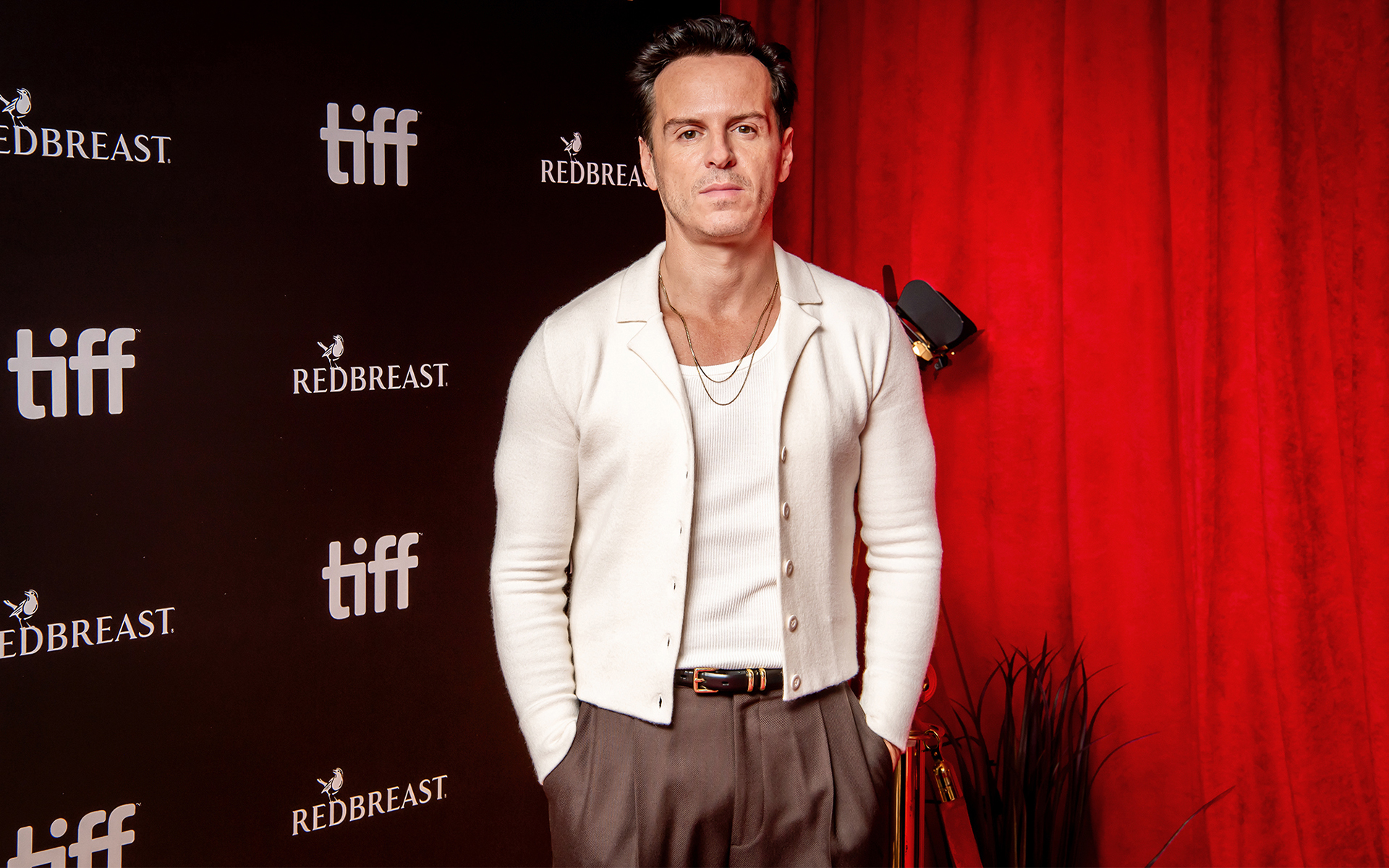
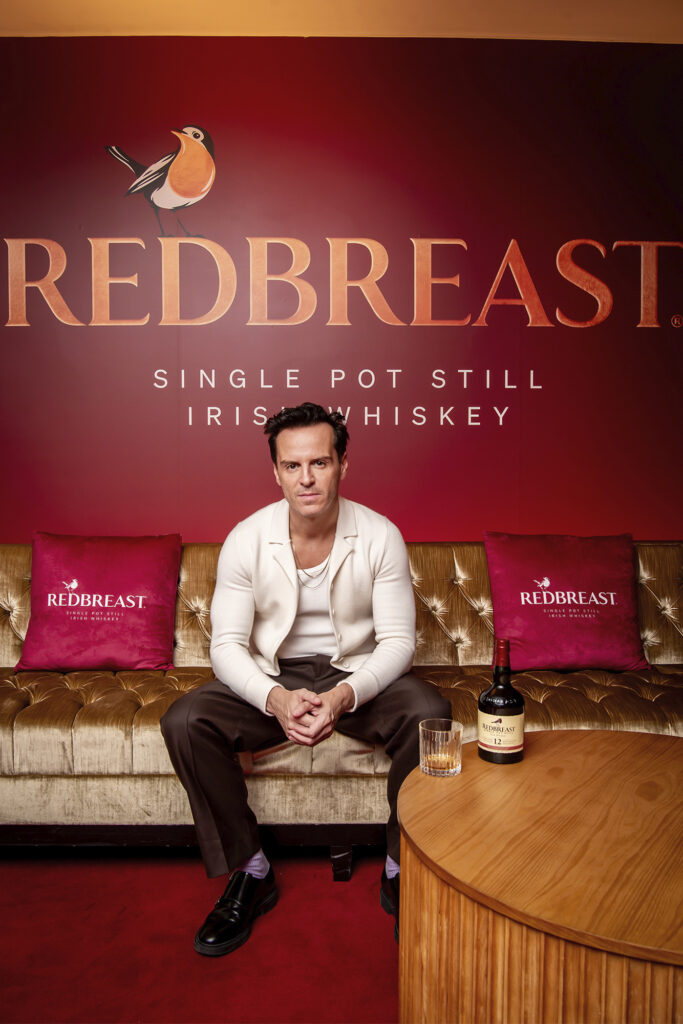
Andrew Scott has style. When I step in the greenroom, he greets me with a handshake and a smile. The actor is in town for the Toronto International Film Festival, where he’ll debut his new film, Elsinore — which would go on to pick up the International People’s Choice Award — but before the premiere, Scott stopped by the Redbreast Red Carpet Suite at Roy Thomson Hall for a conversation about a different role. This one is cast by Redbreast.
“They have this really beautiful initiative called Redbreast Unhidden, which is discovering new talent in the film industry,” Scott says. “That seemed, to me, a really beautiful sentiment.” Redbreast Unhidden is the brand’s global platform, designed to support hidden gems in film and the creative voices behind them. Scott is now in his second year as Redbreast’s Global Brand Ambassador, first partnering with the whiskey label in 2025.
“The people whose work is the most effective are the ones who have the courage to show everybody who they are.”Andrew Scott
Earlier this year, the brand held the Redbreast Unhidden Awards at South by Southwest (SXSW) in Austin, Texas. The awards spotlight narrative short films; a selection of “must-see” entries play during the festival, with the winning film announced at the SXSW Film & TV Awards. This year, Pranav Bhasin’s We Were Here — a comedic short set in “a crumbling Indian town” — earned the Redbreast Unhidden Award. “One of the hardest things to do is comedy,” Scott says of the film. “To use comedy to throw light on quite a serious subject is, to my mind, very brave.”
As the actor explains, emerging talent provides endless inspiration. I sat down with Andrew Scott to hear his thoughts on short films, Irish whiskey, and what we can learn from today’s young filmmakers.
The partnership with Redbreast pairs two big cultural touchstones: film and food/drink. How did you first hear about Redbreast Unhidden, and what were some of your first thoughts when you learned that the label wanted to work together?
Redbreast, a single pot still Irish whiskey, is very… how would you describe it? A very classy, very authentic brand itself. The product is very authentic to its origins — and it’s well made. So, with that in mind, we wanted to look for young artists who were making products that are well made. We did the initiative last year and it was very successful. This year, we’ve continued to do it — just finding new artists that haven’t had a platform and trying to help them in whatever way we can.
The competition at SXSW connects you with a lot of emerging talent across the globe. Being someone who’s very established in his career, how does it feel to get in touch with those participants? Does it bring something new to the way that you think about acting and filmmaking?
Oh yeah, for sure. That’s actually the thing you feel — like, you’re put in a position where you’re going to benefit people, but actually it turns out [that you] benefit just as much. Just seeing what people’s viewpoints are in the industry — or even the visual language they’re using, or just to hear just any sort of stories in short form — is really, really inspiring. It’s amazing time after time.
You really learn that the people whose work is the most effective are the ones who have the courage to show everybody who they are — whether that’s visually or whether that’s in the subject matter [or] how they construct their script — and that’s really inspiring.
Sometimes, that energy can dissipate as you move into the more commercial side of the industry; making sure that your film performs at the box office and all those kinds of commercial imperatives. Because short film is a less-commercial imperative, you’re just free to do whatever you want, as long as it engages with whoever’s watching.
Yeah, absolutely. Do you have experience working on short films yourself? Were there any memories that maybe brought back?
Yeah. You know, so much about filmmaking is very practical: Have we got enough light? Have we got enough money? Is the camera pointing in the right way? How are we going to — with this limited amount of money, which you usually have with a short film — create the atmosphere that’s needed?
When I was working on short films, the thing that I learned was to actually create. And, because you have the freedom, because you don’t have the pressure of like, ‘Oh, this is gonna be on TV necessarily in three weeks, and then my family is gonna see it,’ you can sort of go, ‘Well, I don’t know what the end goal for this film is.’ So, in that sense, it can unleash you to be a little bit braver, more experimental. When you see the film, you go, ‘Oh, I could have been stiller there.’ Or, [you] actually understand that the reason that that scene doesn’t work as well as it could have, is because we rushed it— because we were too slavish to the way we thought it should be, rather than the way it was on the day [we filmed]. All those things, you learn early on set.
The winning short this year at SXSW, We Were Here, is a comedy about three men protesting AI by acting like appliances — so, very unique concept. Can you remember the first time that you saw the film? And, after getting to know some of the minds behind it, did you learn anything that challenged or changed your initial view?
I just thought it was extraordinarily accomplished. One of the hardest things to do is comedy. As a young artist, one of the things that we want the most is to be taken seriously. Because we’re emerging from our youth, and you’re like, ‘I want to be taken seriously.’ So that’s, of course, a very noble thing to want. But to have an idea of playfulness — to understand that comedy is a serious business and to have the audacity to use comedy to throw light on quite a serious subject — is, to my mind, very brave. It shows signs of a very exciting artist.
It wasn’t too long. The acting is completely wonderful. The design is kind of makeshift, but also just very pleasing and fun to watch. It really said something, and I think it sticks in the memories of everybody who watches, which is a very important thing in filmmaking — visuals that don’t leave your mind.
The world has talked so much about artificial intelligence in recent years. I wanted to learn about how the project might have validated — or challenged or put a new perspective on — the way you think of these new technologies in creative fields.
What’s absolutely extraordinary about this film is that it’s so low-fi, you know? It doesn’t shy away from the fact that there isn’t a big budget. So, some of these machines that are made are literally made of cardboard. The lack of smoothness and the kind of analogue nature of the film is really highlighted. The fact that some of these machines are quite obviously and intentionally made out of bits of dirty cardboard makes it really, really funny — but it’s still really well designed. It’s very human in that sense. I love that about it.
Yeah, absolutely. I think those human qualities are kind of the beauty of the creative process.
For sure. That’s the kind of stuff I like to see.
“To embed ourselves fully into a story is genuinely pleasurable and relaxing, even if it’s scary or thrilling.”Andrew Scott
Another standout was a short called Visitors, which was described as a tense horror film. That caught my eye because of the way that horror has had such a resurgence in recent years. Why do you think the genre resonates with today’s viewers?
Yeah, it’s an interesting one. Why do you think?
I think the things we’re afraid of can open our eyes to feelings we might have about things in the real world.
Yeah. I do think that social media has made us more anxious. The world really seems bigger. You wake up in the morning and before you’re even upright, you’re looking at twenty different viewpoints from around the world. Things that you didn’t even look up; you’re just being offered them. I think that’s very anxious-making. It feels like there’s just this never-ending stream of possibility. A never ending stream of possibility is terrifying. [Laughs]. Or, it can be terrifying, you know? It’s exciting, but to have a smaller, calmer world in some ways is… more preferable. Social media has just opened us up.
Horror isn’t something that I’ve always embraced, myself. I think the world’s divided into people who really love horror and people are like, ‘Oh, no, why would I want to be scared? Why would I want to go on a roller coaster if I can just be on my couch?’ People seek thrills in completely different ways. What I love about the horror experience is that, in a cinema, when you’re watching a big horror film, everybody’s screaming at the same time. Even though everybody’s terrified, it is still a communal experience.
Yeah, yeah, there’s that sense of camaraderie.
Exactly. And then people laugh at the other people screaming. It’s fun.
As you’re reviewing all of the submissions to the Redbreast Unhidden Awards at SXSW, I’d imagine there’s a huge range of genres and topics. Did you notice any common threads across the submissions?
Do you know what? I was really struck by how disparate the different films were. They really were. You’d go from one psychosexual thriller to one very crazy, surreal one, to a funny one, to something that’s very slow moving, still, and softly spoken. I really loved that about it, particularly in a short film, because you have the bandwidth to look at all of those in a row; fifteen minutes or twenty minutes, or seven minutes. What’s interesting is that longer doesn’t necessarily mean better. It was amazing to look at a film that might be seven minutes long; [the filmmakers are] confident enough to go, ‘I don’t need to use twenty minutes.’
But no, it was wild to me, the huge range of things. That makes me excited. You think horror, for example, is really popular at the moment, so there’s a lot of horror films — but some people are like, ‘No, I’m, like, twenty-two years old, and I like period drama: dialogue-lead films. That’s what I wanna do.’ Long may that continue.
Yeah. I think it shows that there’s so much appetite for original stories, too.
Yeah, and what people — when they’re on their laptop, in their bed — what they choose to watch: a Merchant Ivory film from the nineties or grunge films in Seattle from fifteen years ago. It’s cool that people are able to access films in an easier way. There used to be, like, Blockbuster video stores or whatever. It was harder. The physical idea of going, ‘Okay, well, I want to watch that.’ It was a completely different scenario.
“The Irishness of [Redbreast] is very important to me. Emigration was a huge part of our culture. Members of our country had to leave in order to survive. You keep the memory of those people alive by talking about them, by telling stories about them.”Andrew Scott
That’s something else I wanted to touch on. Throughout the last decade or two, film has really undergone a huge change: cable to DVD to streaming. We have this kind of paralysis of choice, right? When you work with today’s filmmakers, do you notice that has had an impact on the way they think about or conceptualize film?
I don’t think there is. I mean, I guess it must have in some ways, but I don’t know. What do you feel like? When you watch a movie, do you feel like you go to the movies less than you used to?
No, not at all. But I think you notice it more with music. Track lengths, for example, I’ve gotten a lot shorter with streaming over the years.
That’s so true. I suppose it’s not so much how we go and see films, but how we watch them. The double screening thing is worrying, because particularly in film, stillness or silence is incredibly important. But, of course, if you’re not looking at the screen, you just think, ‘Okay, well, nothing’s happening.’ Some of the most cinematic moments in film history are completely silent. When somebody’s just looking around, and everyone’s like, ‘Ahhh!’ You know what I mean? I’m thinking of Halloween or something, when that guy appears behind. It’s completely silent before the soundtrack kicks in.
So, double screening — and TikTok and all that where our attention spans get faster and faster and faster, ‘What is this? What was that?’ — is a little worrying. But I still think there’s enormously inventive stuff in that form, too. Like with every advancement, there are positives and negatives. I just like the idea of focussing on one thing at the same time, if possible. To embed ourselves fully into a story is genuinely pleasurable and relaxing, even if it’s scary or thrilling. You know what I mean? If you’re reading a book and you’re texting at the same time, it’s impossible. They’re different forms of storytelling. When you’re watching a movie with someone and they’re on their phone, you’re like, ‘You’re not really paying attention to this.”
You’re not really in the moment with them.
Exactly. Yeah. I hope, with these little tiny screens, that we’re in the early stages of understanding that there is a real limit to their value in our life.
Last question: I want to know if you have any kind of personal takeaways from working with an Irish whiskey brand on something creative. Did the Irish connection add anything to the partnership or why it made sense for you?
The Irishness of it is very important to me. Emigration was a huge part of our culture. Members of our country had to leave in order to survive. You keep the memory of those people alive by talking about them, by telling stories about them. I think that’s why the storytelling tradition in Ireland is so strong. The literary tradition in Ireland is very strong. It’s great that so many of my contemporaries as actors are doing well internationally, you know? It makes me very, very proud.
A lot of the stories you tell about the people that have left the country happened, in Ireland, in a pub. So, rather than it just being a party aid — you know, alcohol — it’s actually something that really, really brings people together, and maybe relaxes people enough to talk about things that they need to talk about. So in that way, it makes sense to me. The fact that it’s an Irish brand means a lot to me because obviously that’s a big part of my identity.
This transcript has been edited and condensed for length and clarity.
FEATURE PHOTO COURTESY OF REDBREAST.